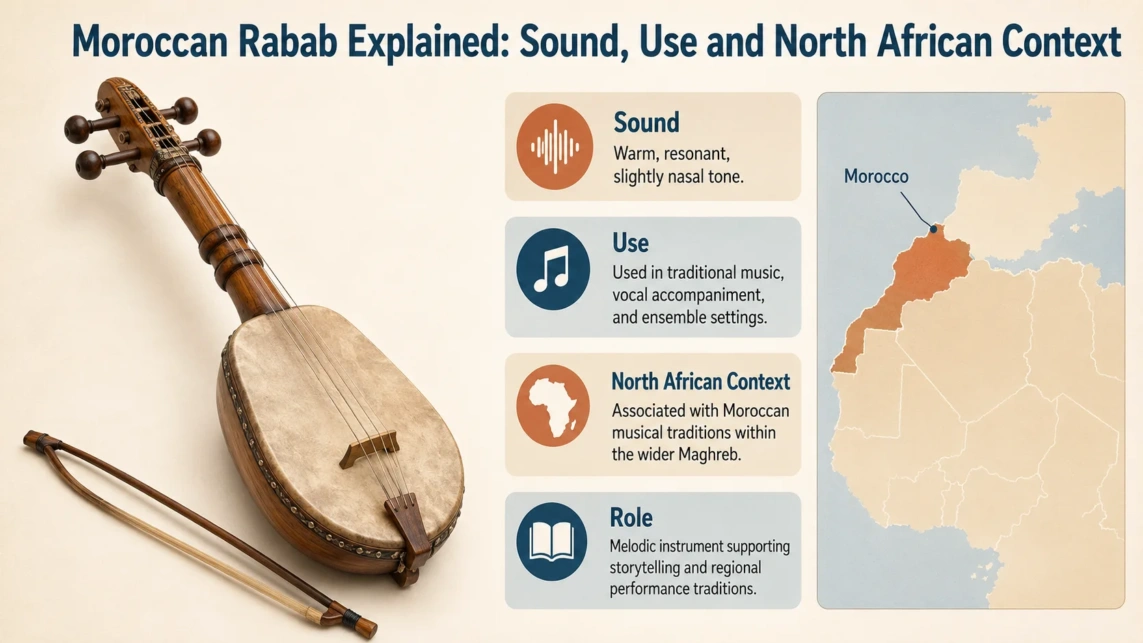
The Moroccan rabab is best understood as a bowed North African string instrument rather than a single fixed design. In Morocco, the name can point to the short-necked rabab heard in Andalusi-Maghrebi music, but it can also be used for related regional fiddles such as the Soussi ribab of southern Morocco. The shared idea is clear: a resonant body, one or more strings, and a bowed sound that carries melody with a nasal, grainy, vocal-like edge.
What the Moroccan Rabab Is
The Moroccan rabab belongs to the wider rabab, rebab, rabāb, rbab, and ribab family of bowed string instruments. Across North Africa and the Arabic-speaking world, these names do not always describe the same object. They can refer to different bowed lutes, spike fiddles, skin-faced instruments, or local folk fiddles.
In a Moroccan setting, the term usually needs context. A museum label, an Andalusi music ensemble, and an Amazigh village performance may all use a related name while pointing to different construction details.
Regional Note: The most useful way to identify a Moroccan rabab is not by name alone. Look at the body shape, number of strings, soundboard material, bowing method, and musical setting. Those details explain more than spelling does.
Main Details Worth Knowing
| Feature | What to Look For | Why It Matters |
|---|---|---|
| Instrument family | Bowed string instrument, often described as a bowed lute or fiddle depending on the form | It places the instrument within the wider rabab tradition without assuming one fixed model |
| Region | Morocco and the wider Maghreb, with links to Tunisia, Algeria, and Andalusi musical culture | The North African setting shapes both design and repertoire |
| Soundboard | Skin-covered bodies appear in several documented forms; some related forms use other local solutions | Skin can give the tone a dry, direct attack and a focused resonance |
| Strings | May be one, two, or more strings depending on the regional type | String count is one of the easiest ways to separate Moroccan rabab forms |
| Playing method | Usually bowed, held upright or angled according to local practice | The bow helps produce sustained melody and ornamented lines |
| Common confusion | Often mixed up with Afghan rubab, Javanese rebab, rebec, or generic “rabab” labels | Similar names do not always mean similar construction or musical role |
Names and Spellings in Moroccan and North African Use
The spelling changes because the word moved through Arabic, Amazigh, European, and museum cataloguing traditions. Common forms include rabab, rebab, rabāb, rbab, ribab, and rbeb. These spellings may overlap, but they are not always interchangeable in practice.
Older catalogues may use “Berber” for Amazigh-related instruments. Current writing often prefers Amazigh when referring to the people, languages, and regional traditions of Morocco and North Africa. When a museum object uses an older label, the label should be read as a historical catalogue term rather than a full cultural description.
Why the Name Alone Is Not Enough
Across the wider rabab family, a similar name can describe a plucked Afghan rubab, a bowed Javanese rebab, a medieval rebec-related instrument, or a North African bowed lute. A Moroccan rabab page therefore needs to explain the instrument by form and use, not only by spelling.
- Rabab or rebab: Broad spellings used for several bowed string instruments.
- Rbab or rbeb: Spellings often seen in Maghrebi and Moroccan contexts.
- Ribab: Often used for regional Moroccan or Amazigh fiddle forms.
- Rubab: Commonly linked to Central and South Asian plucked lute forms, especially Afghan rubab.
Two Moroccan Contexts That Often Get Mixed Together
Moroccan rabab can refer to more than one instrument tradition. The two most useful reference points are the Maghrebi or Andalusi rabab and the Soussi ribab. They are related through name, bowing, and regional history, but they should not be treated as the same object.
| Form | Typical Context | Common Physical Clues | Main Role |
|---|---|---|---|
| Maghrebi or Andalusi rabab | Urban North African and Moroccan Andalusi music settings | Short-necked bowed lute form; examples may have a skin soundboard and a hollowed wooden neck cover | Melodic line, ensemble color, and ornamented phrasing |
| Soussi ribab | Southern Moroccan Amazigh music, especially in Souss-related contexts | Often described as a single-string fiddle with a skin-covered resonator and lateral peg | Lead melody, vocal support, and rhythmic-melodic drive |
| Museum-labelled North African rabab | Catalogues may group examples from Morocco, Algeria, Tunisia, or the wider Maghreb | May show pear or teardrop forms, skin tables, wood necks, decorative inlay, and regional string setups | Reference object for comparing regional construction |
Body Shape and Construction
The Moroccan rabab is often built around a compact resonator rather than the deep bowl of a large lute. In documented North African examples, the table may be pear-shaped or teardrop-like, with a skin soundboard fixed over the body. The back can be rounded or hollowed, depending on the type.
Wood is used for the neck, bridge, pegbox, and body structure in many examples. Decorative work may include inlay or carved surfaces, but ornament should not distract from the functional parts: string path, bridge height, soundboard tension, and the contact between body and neck.
Skin Soundboard
A skin soundboard gives several Moroccan and North African rabab forms a direct, compact response. It can support a tone that feels closer to speech than to the smooth sustain of a violin. The sound may be dry, slightly nasal, and quick to speak under the bow.
Skin tension, body size, bridge shape, and string material all affect the final voice. A small change in setup can alter response. For that reason, one surviving example should not be used as the standard for all Moroccan rababs.
Neck, Pegs, and String Path
Some Moroccan rabab examples use a wooden cover over a hollowed neck. In nearby North African examples, catalogues sometimes note decorative brass or other regional surface treatments. These details help separate Moroccan, Algerian, and broader Maghrebi variants, although borders in instrument practice are not always neat.
On Soussi ribab forms, the peg may sit laterally, and the single string can cross the soundboard at an angle. This angled string path is a useful visual clue when identifying the instrument in photographs or museum collections.
Luthier’s Note: Wood choice can shape resonance, but the rabab’s voice is not decided by wood alone. Skin tension, bridge cut, string material, bow pressure, and local playing technique all help form the sound.
Strings and Bowing
String count varies by regional form. The Moroccan Andalusi rabab is often described as a bowed instrument with a small number of strings, while the Soussi ribab is widely identified as a single-string fiddle. Museum examples from North Africa may also show three simple strings, especially when the object belongs to a broader regional or Amazigh category.
This variation matters. A single-string ribab asks the player to create pitch movement, ornament, and expression on one main sounding line. A two-string or multi-string rabab allows a different relation between melody, drone, and resonance.
The Bowed Voice
The bow does not make the Moroccan rabab sound like a violin. The instrument usually has a more compact range of color. Its tone can be reedy, narrow, and strong in the middle register. When played well, the sound cuts through hand percussion and voices without needing a large body.
The bowing often favors short gestures, slides, ornaments, and sustained notes that lean into vocal phrasing. The result is shaped for local melody, ensemble balance, and direct communication rather than orchestral projection.
Listening Note: A Moroccan rabab line often sounds closest to a singer’s ornamented phrase. Listen for sliding pitch, tight bow control, and a tone that stays focused rather than wide and glossy.
How the Moroccan Rabab Sounds
The Moroccan rabab is known for a sound that is focused, nasal, and expressive. The attack can be firm because the bow grabs the string quickly. The sustain is usually more intimate than a violin or kamancheh, especially when the body is small and the soundboard is skin.
Its resonance tends to sit in a narrow band. That is not a weakness. It helps the instrument hold a melodic line inside an ensemble where voices, hand drums, plucked strings, and other instruments may already occupy a wide space.
Common Sound Traits
- Nasal color: A tight, reed-like tone that can carry through a group.
- Dry resonance: Skin-covered bodies may speak quickly and decay more directly than wooden soundboards.
- Vocal phrasing: Slides and ornaments can imitate sung melodic movement.
- Small-body focus: The tone is not usually wide or bass-heavy.
- Regional variation: A Soussi ribab, an Andalusi rabab, and a museum object may not sound alike.
Use in Moroccan and North African Music
In Moroccan Andalusi music, the rabab belongs to an ensemble culture tied to the Maghreb and to the legacy of al-Andalus. It may sit with instruments such as oud, violin, qanun, percussion, and voices, depending on the ensemble and local tradition. Its role is melodic rather than purely rhythmic.
In southern Moroccan Amazigh settings, the Soussi ribab has a different social and musical life. It can support song, dance, and poetic performance. Its single-string sound can act as both lead voice and rhythmic marker when the player uses bowing, ornament, and repeated figures with control.
What the Instrument Does in an Ensemble
The rabab can introduce a melodic idea, shadow a singer, answer a phrase, or thicken the ensemble texture. It is not only a background color. In small settings, it can become the main melodic guide.
- Supports melody: The bowed line can follow or lead the vocal phrase.
- Adds ornament: Slides, turns, and short bowed accents shape the musical identity.
- Marks regional color: Its tone can signal Maghrebi or Moroccan context more clearly than a generic bowed string sound.
- Connects voice and instrument: The phrasing often sits close to sung delivery.
North African Context
The Moroccan rabab belongs to a larger North African story. Similar or related rabab forms appear in Morocco, Algeria, Tunisia, and other Maghrebi contexts. The instrument also connects to older Arabic bowed-instrument terminology and to European medieval instruments such as the rebec, though those links should be handled with care.
The rebec connection is mostly historical and organological. It does not mean that a Moroccan rabab is simply an early violin, nor that all rebecs came from one identical Moroccan model. It means that bowed lutes and fiddles moved across cultural routes, changed shape, and took on new names and functions.
Morocco, Algeria, and Tunisia
North African rabab forms share certain traits, especially short-necked bowed-lute construction and use in traditional Arabic ensembles. Yet regional makers treat the neck, body cover, decoration, and string setup differently. Moroccan examples are often noted for wooden treatment around the hollowed neck, while other Maghrebi examples may show different surface materials or fittings.
Recent research has also widened the material available for comparing these traditions. The 2025 volume Rabab, Rubeba, Rubāb includes Mohamed Khalifa’s study of different Arab rabāb variants and Anis Klibi’s work on the Tunisian rabāb. These studies support treating Moroccan instruments within a wider North African and Arab family while keeping regional construction and performance traditions separate.
These details are small on the page, but large in identification. A collector, musician, or researcher should avoid labelling every Maghrebi bowed lute as “Moroccan” unless the object’s origin, maker, or performance context is known.
Documented Museum Examples and Conservation
The University of Würzburg’s Institut für Musikforschung holds several documented Andalusi rabābs from Morocco and Tunisia. One recent addition, Fos 28, is a Moroccan rabāb made in the 1980s and donated to the collection by Bengt Fosshag on March 9, 2026. The museum record gives unusually precise measurements: 59.7 × 11.3 × 11.5 cm, with a scale length of about 42 cm. It has two gut strings, two lateral tuning pegs, and a short horsehair bow measuring 37 cm.
Those dimensions provide a useful reference for a documented late twentieth-century Andalusi rabāb, but they should not be treated as standard measurements for every Moroccan example. Another Moroccan instrument in the same collection, De 397, measures about 60 × 11 × 12 cm and has a scale length of approximately 41 cm, showing close proportions without establishing a fixed workshop pattern.
3D Reconstruction of a Broken Tuning Peg
De 397 also records how traditional instruments can be conserved with newer museum methods. Its rear left tuning peg had broken, been nailed and glued, and then failed again. In 2025, the missing peg was reproduced by scanning the surviving form and making a 3D-printed replacement. The replacement was then stained to match the color of the instrument.
This type of intervention is different from rebuilding an instrument according to modern preferences. The aim is to replace a damaged functional part while keeping the surviving object and its documented construction as the reference. For instruments such as the rabāb, where peg shape, string alignment, and neck geometry are closely connected, digital scanning can preserve the dimensions of the original part more closely than an unrelated replacement.
Collection Note: Museum measurements describe individual instruments, not a universal Moroccan rabab specification. Fos 28 and De 397 are useful because their dimensions, strings, decoration, provenance, and later conservation work are recorded together.
Moroccan Rabab and Related Instruments
The Moroccan rabab is easy to confuse with other instruments because the names look alike. The safest comparison focuses on construction and playing method.
| Instrument | Main Difference | Useful Identification Clue |
|---|---|---|
| Afghan rubab | Usually a plucked lute, not a bowed Moroccan rabab | Carved body, sympathetic strings in many forms, and plectrum-based playing |
| Javanese rebab | A bowed spike fiddle used in gamelan contexts | Long neck, small resonator, and Southeast Asian ensemble setting |
| European rebec | A medieval bowed instrument with a related name-history but different later context | European iconography, boat-like body forms, and medieval repertory links |
| Violin | A European bowed chordophone with a standardized modern form | Four strings, arched wooden plates, fingerboard, and shoulder or chest position |
| Kamancheh | A bowed spike fiddle used across Persianate and neighboring traditions | Spike support, rounded body, and a different playing posture |
How to Identify a Moroccan Rabab
Identification works best when several clues agree. One clue alone can mislead, especially because the word rabab has been used across many regions.
Physical Clues
- A compact body rather than a large lute bowl
- A skin soundboard in many documented examples
- A short neck or regional fiddle neck rather than a long fretted lute neck
- One, two, or several strings, depending on form
- A bow as the main playing tool
- Local decorative work, inlay, or carved wooden details
Context Clues
- Moroccan Andalusi ensemble setting
- Amazigh performance context in southern Morocco
- Maghrebi museum catalogue origin
- Arabic or Amazigh naming variants such as rbab, rbeb, or ribab
- Use with song, poetry, or small ensemble melody
Collector’s Note: A label reading “rabab” is not enough for accurate identification. Check the region, body, soundboard, string count, and whether the object is bowed or plucked before assigning a Moroccan or Maghrebi type.
Materials and Playing Feel
The tactile feel of the Moroccan rabab comes from its mixed materials. Wood gives the structure. Skin gives the soundboard its immediate response. The bridge transfers the string vibration into the resonator, and the bow controls pressure, speed, and articulation.
On a small skin-faced instrument, setup can feel sensitive. If the bridge is too high, the player may fight the string. If the skin is too slack, the tone can lose focus. If the bow is too heavy, ornaments may sound rough rather than shaped. These are normal concerns for bowed folk and court instruments, not signs of poor design.
Decoration and Craft
Some Moroccan and North African rabab examples include bone, mother-of-pearl, dark paste, carved wood, or patterned surfaces. Decoration may show regional taste, maker identity, or owner preference. It should be read alongside construction, not as a separate display layer.
The most useful craft details are often practical: how the skin is fixed, how the neck joins the body, how the peg holds tension, and how the bridge stands on the soundboard. These parts tell the instrument’s working story.
Common Misunderstandings
Several mistakes appear often in short descriptions of the Moroccan rabab.
“It Is the Same as the Afghan Rubab”
It is not. The Afghan rubab is usually a plucked lute with a different body design, playing technique, and musical setting. The Moroccan rabab is normally discussed as a bowed North African instrument.
“Every Rabab Has the Same Number of Strings”
No. Moroccan and North African rabab forms may have different string counts. The Soussi ribab is commonly described as single-string, while other Maghrebi examples may have two or more strings.
“It Is Just an Old Violin”
The rabab and the violin are both bowed string instruments, but the comparison can hide more than it explains. The Moroccan rabab has its own body structure, soundboard behavior, tonal aim, and performance setting.
“The Word Rbab Always Means the Same Instrument”
Spelling varies by language, region, and catalogue habit. The object itself must be checked before the name can be understood.
Learning and Listening Context
Beginners who approach the Moroccan rabab from the violin or cello may expect fixed positions, smooth sustain, and a standardized method. That expectation can be unhelpful. The instrument asks for close listening, flexible intonation, and comfort with ornamented melodic movement.
For listeners, the best starting point is to hear the rabab inside its musical setting rather than as an isolated sound sample. The tone makes more sense when heard beside singing, hand percussion, oud, or other ensemble instruments.
What to Listen For First
- The way the bowed line follows the contour of the voice
- Short ornaments before or after main notes
- Slides that connect pitches rather than separate them cleanly
- The dry response of a skin-faced body
- The difference between urban Andalusi use and southern Moroccan ribab use