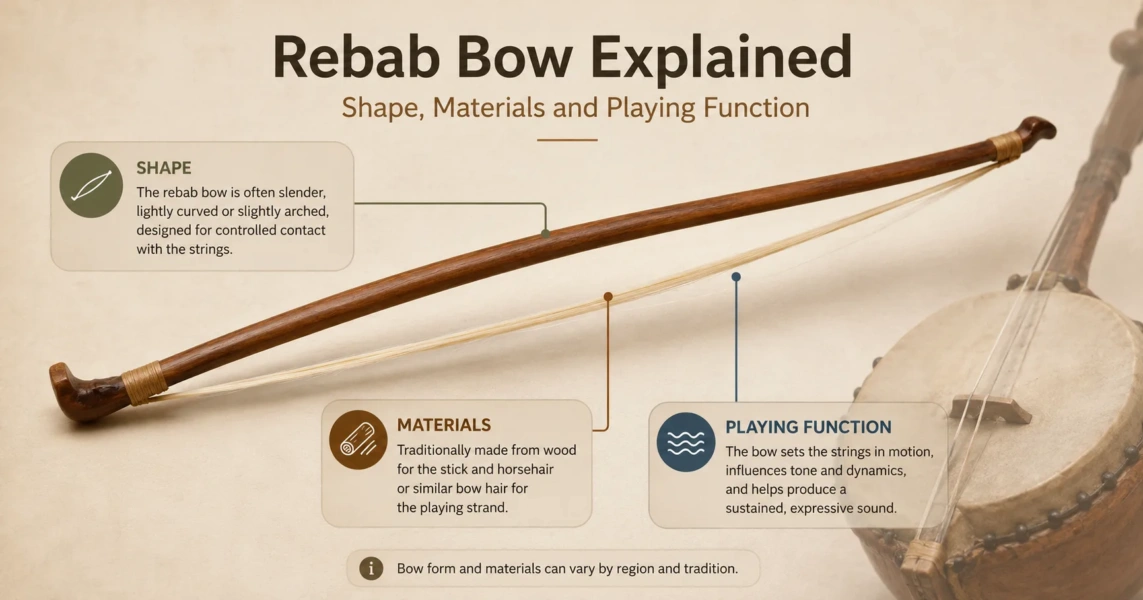
The rebab bow is a small part of the instrument, but it controls much of the sound. On bowed rebab, rabab, rabāba, rebap and related instruments, the bow is not only a tool for setting the string in motion. Its curve, weight, hair tension and grip help decide whether the tone feels thin, vocal, dry, nasal, soft or sharply textured.
What a Rebab Bow Is
A rebab bow is a handheld bow used to draw sound from the strings of a bowed rebab-type instrument. It usually consists of a shaped stick and a band of hair or fiber stretched between the ends. The player moves this hair across the string so that friction starts the vibration.
Unlike the modern violin bow, the rebab bow does not have one global standard. Some examples are plain and functional. Others, especially in courtly or ceremonial collections, may be carved, painted, gilded or decorated. The working idea remains simple: a flexible stick holds bow hair under enough tension to catch the string and keep the note alive.
This point matters because the word rebab covers a family of instruments rather than one fixed design. A bowed spike fiddle from North Africa, a Javanese gamelan rebab, a Bedouin rabāba and a Southeast Asian rebab may all use bows, but their bows can differ in length, curve, decoration, grip and playing feel.
Bow Shape and Basic Parts
Most rebab bows can be understood through four visible parts: the stick, the hair, the handle area and the tip. The exact names used by makers vary by region, but the physical roles are easy to observe.
| Part | Function | What It Affects |
|---|---|---|
| Stick | Holds the bow shape and gives the player leverage. | Weight, balance, flexibility and control. |
| Hair or Fiber | Touches the string and creates friction. | Attack, texture, grip and steadiness of tone. |
| Handle Area | Gives the hand a place to hold and guide the bow. | Comfort, angle and pressure control. |
| Tip | Anchors one end of the hair and completes the bow curve. | Hair spread, tension and balance near the end of the stroke. |
The stick may be nearly straight, gently arched or more visibly curved. A strong curve can help separate the stick from the hair and give the player room to work. A plainer stick may rely more on the player’s fingers to manage the hair tension during performance.
Some rebab bows look loose when compared with a violin bow. This does not mean they are unfinished or defective. In several traditional bowed instruments, the player can tighten or relax the bow hair by hand while playing. That direct control is part of the instrument’s response.
How Bow Tension Works
Bow tension is one of the most important features of a rebab bow. If the hair is too loose, it may fail to grip the string cleanly. If it is too tight, the sound can become hard, thin or difficult to shape. The best tension depends on the instrument, string material, bridge height, playing style and the player’s hand.
Modern violin bows use a screw mechanism to adjust tension. Many rebab bows do not follow that design. Some use fixed tension. Some use a simple tied construction. Some allow the player to pull the hair against the fingers while bowing.
Luthier’s Note: A loose-looking rebab bow should not be judged by violin standards alone. On some regional bows, hand-controlled tension gives the player a flexible attack and a more speech-like line.
This flexible tension can help with ornaments. A player can soften the start of a note, lean into a stronger stroke, or let the sound fade with less mechanical stiffness. It also makes the bow less forgiving. Small changes in hand pressure can be heard immediately.
Traditional Materials
Rebab bows are commonly made from wood and hair, but the exact materials vary. Museum objects and surviving traditional bows show both plain working designs and decorated examples made with carved or painted wood. In some historical Javanese examples, the bow may be ornamented as part of a larger gamelan instrument set.
The stick may be made from a local wood chosen for lightness, availability and workability. It needs enough strength to hold shape, but it should not feel heavy in the hand. A bow that is too heavy can slow the stroke and make the sound feel forced.
The hair is often described as horsehair in many bowed-string traditions. Other natural fibers or modern substitutes may appear, especially on repaired, student or recently made instruments. The important point is not only the material itself, but the surface friction it gives against the string.
| Material Area | Common Choices | Practical Role |
|---|---|---|
| Stick | Local hardwood, light carved wood, sometimes decorated wood. | Supports the bow curve and affects balance in the hand. |
| Bow Hair | Horsehair or other natural or modern fibers, depending on region and repair history. | Creates friction against the string. |
| Binding | Thread, cord, wrapping or tied construction. | Secures the hair and helps maintain usable tension. |
| Decoration | Paint, carving, gilding or simple surface finish. | May show regional taste, status or collection context; it does not replace playing function. |
Rosin or resin may be used to help the hair grip the string. Without enough friction, the bow can slide weakly and produce a thin, unstable sound. With too much grip, the attack can become rough. Players often learn this balance by feel rather than by measurement.
How the Bow Makes the Rebab Speak
A bowed string does not sound because the bow simply rubs across it. The bow hair grips the string for a moment, pulls it sideways, then releases it. This repeating grip-and-release motion starts the vibration. The bridge carries that vibration into the body and soundboard.
On many bowed rebab forms, the soundboard may be skin or membrane rather than a thick carved wooden top. This can give the sound a quick response and a close, direct character. The bow has to work with that body. Heavy pressure can choke the tone, while too little pressure may fail to start the note clearly.
The rebab bow therefore shapes three parts of the sound:
- Attack: how the note begins.
- Sustain: how the note continues under the bow.
- Texture: how smooth, breathy, grainy or nasal the tone feels.
A skilled player can make a simple bow produce many shades. A slower stroke may let the note open gently. A firmer stroke can give a sharper entry. Short repeated strokes can support rhythmic patterns, while longer strokes can carry a sung melodic line.
Playing Position and Bow Angle
The playing position changes from region to region. Some rebab-type instruments are held upright against the body or placed with a spike or lower end resting downward. Others sit in the player’s lap or are held at an angle. The bow follows the instrument’s position.
Because many rebab instruments have a small body and a narrow string path, the bowing angle can be delicate. The player may use a compact stroke instead of the long arm movement associated with violin playing. Wrist, fingers and forearm often do more of the work than broad shoulder motion.
The bow may contact one string or move between two or more strings, depending on the instrument. On one-string rabāba traditions, the bow focuses on a single melodic line. On two-string or three-string rebab forms, the bow can support melody, drone contact, ornaments or quick changes between strings.
Why Rebab Bows Are Not All the Same
The safest way to describe the rebab bow is as a regional tool, not a universal pattern. The bow belongs to the local instrument it serves. A bow made for a Javanese rebab in gamelan music is not the same object as a bow used for a Bedouin rabāba or a North African rebab.
Several features can change by region:
- Length of the stick
- Amount of curve
- Hair tension method
- Decoration and surface finish
- Grip position
- Use of horsehair, substitute fiber or later repair materials
- How much pressure the playing style requires
This variety is one reason rebab bows can be difficult to identify in isolation. A bow should be read together with the instrument body, string layout, bridge, soundboard and regional setting.
Collector’s Note: A decorated rebab bow may look like a display object, but wear near the grip, hair attachment, old repairs and matching scale can reveal whether it was made for use, ceremony, collection, or later reconstruction.
Bowed Rebab vs Plucked Rubab
The bow also helps separate bowed rebab instruments from plucked rubab forms. The spelling can be confusing. In many contexts, rebab, rabab and rubab are related names, but they do not always describe the same playing method.
Some instruments in this naming family are bowed. Others, such as many Afghan and Central Asian rubab forms, are plucked with a plectrum rather than bowed. Those plucked instruments may have a carved wooden body, melody strings, drone strings and sympathetic strings. Their sound comes from striking or plucking, not from bow hair pulling the string into vibration.
| Name or Form | Typical Playing Method | Bow Relevance |
|---|---|---|
| Bowed Rebab | Bowed melody instrument. | The bow is central to tone and phrasing. |
| Rabāba / Rababa | Often bowed, with strong regional variation. | The bow may be simple and closely tied to vocal-style melody. |
| Javanese Rebab | Bowed instrument in gamelan settings. | The bow supports smooth melodic movement and may be finely decorated. |
| Afghan Rubab | Usually plucked with a plectrum. | A bow is not part of its normal playing method. |
Sound Qualities Shaped by the Bow
The rebab bow is closely tied to the instrument’s voice-like quality. Bowed rebab tones often feel narrow, focused and flexible rather than broad and polished. The bow can draw out small pitch slides, ornaments and pressure changes that resemble sung phrasing.
Several bow actions shape the result:
- Light pressure can make the tone airy or fragile.
- Firm pressure can add bite, but too much can crush the vibration.
- Slow bowing can support sustained melody.
- Short strokes can mark rhythm and articulation.
- Changing hair tension can soften or sharpen the note while it sounds.
The bow does not act alone. String material, bridge fit, soundboard type, body size and left-hand technique all matter. Still, the bow is the player’s first contact with the sound. It turns a quiet string into a speaking line.
Signs of a Well-Matched Bow
A good rebab bow does not need to look refined in a modern orchestral sense. It needs to match the instrument and the playing style. The hair should meet the string cleanly. The stick should feel light enough to guide. The grip should allow pressure changes without strain.
Useful signs include:
- The bow starts the note without scraping heavily.
- The hair keeps contact through slow and short strokes.
- The player can change pressure without losing control.
- The bow feels balanced for the instrument’s position.
- The tone can move from soft to stronger without collapsing.
Old bows may lose hair, tension or straightness. Replacement hair is common in instrument maintenance, but a repair should respect the bow’s scale and original working style. A heavy modern replacement can make a light rebab feel stiff and unnatural.
Care and Handling
Rebab bows are often lighter and more exposed than modern violin bows. Hair, binding and old finishes can be fragile. Heat, dryness, humidity and rough handling may affect tension or loosen old repairs.
Basic care is simple: store the bow where it will not be bent, keep it away from damp conditions, avoid touching the hair too often with bare fingers, and do not force the stick into a tension it was not built to hold. If the bow belongs to an old instrument, repairs should be done with attention to the regional form rather than with generic violin-shop assumptions.
Material Note: The bow’s value is not only in rare wood or decoration. In a working rebab, the most important test is whether the bow can create a controlled, living tone on that specific instrument.
How to Identify a Rebab Bow
A rebab bow is best identified through context. A loose bow with a curved wooden stick and hair may belong to several bowed folk instruments, not only a rebab. The instrument body, regional origin, string count and playing tradition help confirm the match.
Look for proportion first. A bow that fits the scale of the instrument is more convincing than one that merely looks old. Then examine the hair attachment, grip wear, decoration style and any labels or collection notes. A museum record may identify a bow as a rebab bow even when the original hair has been replaced or altered later.
For players, the question is more practical: does the bow let the instrument speak? If it can start the note, sustain the line, support ornaments and respond to pressure, it is doing the work a rebab bow is meant to do.