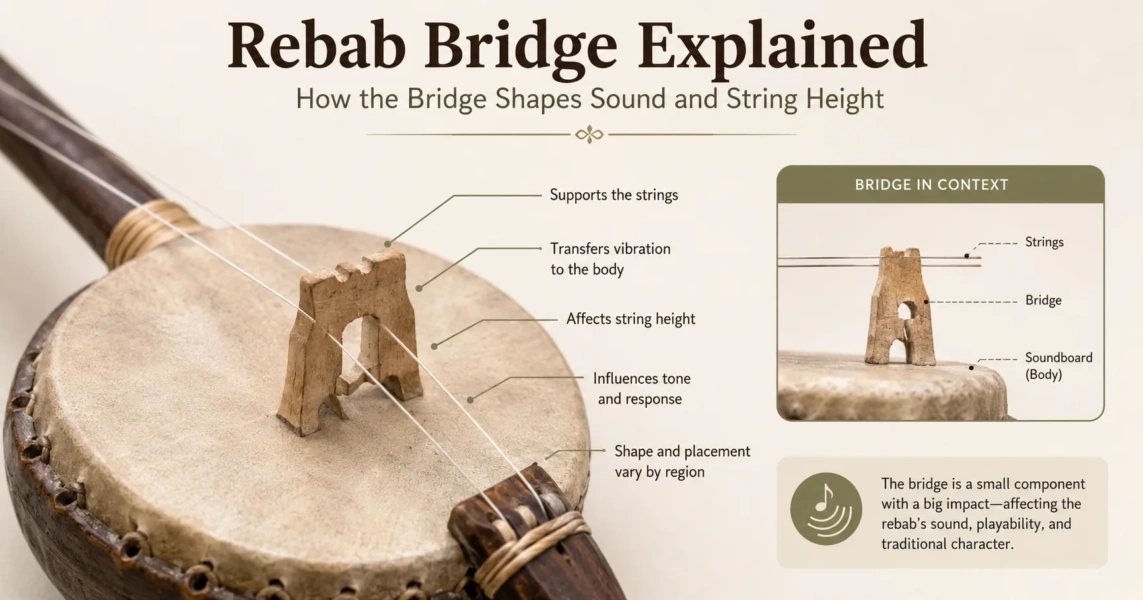
The bridge on a rebab is a small part with a large job. It lifts the strings, spaces them, carries vibration into the soundboard, and helps decide whether the instrument feels easy, stiff, clear, dry, nasal, bright, or muted. On many rebab-family instruments, the bridge is not just a support. It is the point where string tension, skin tension, body shape, and playing style meet.
What the Bridge Does on a Rebab
A rebab bridge sits between the strings and the resonating surface of the instrument. When a string is bowed or plucked, the bridge receives that motion and passes it into the soundboard. The soundboard may be skin, parchment, hide, rawhide, or wood, depending on the regional form.
This is why the bridge matters so much. A string vibrating in the air makes little sound by itself. The bridge helps the body of the instrument speak.
In simple terms, the bridge has four main roles:
- It holds the strings at a playable height above the neck or body.
- It transfers string vibration to the skin or soundboard.
- It controls string spacing and bow or plectrum access.
- It affects tone by changing pressure, contact, mass, and response.
The details vary widely. A one-string Bedouin rababa, a two-string Javanese rebab, a North African rabab, and an Afghan rubab do not use the same bridge design. They share a principle, not a single standard part.
Why the Rebab Bridge Is Not Like a Violin Bridge
The violin bridge is tall, thin, precisely arched, and cut for four strings under high, controlled tension. Many rebab bridges are simpler, lower, flatter, heavier, or more direct. Some are little more than a shaped block of wood. Others are carved and fitted with more care, especially on instruments with several string courses.
This difference comes from the structure of the instrument. Many rebab-family instruments have skin soundboards rather than thick carved wooden tops. A bridge sitting on skin behaves differently from a bridge standing on spruce. The membrane can flex, stretch, dry, loosen, or tighten with weather and age.
On skin-topped instruments, the bridge often works with a living, changing surface. That gives many rebabs their close, dry, immediate tone. It also means the setup may be less fixed than on a modern violin or guitar.
| Bridge Feature | What It Changes | What the Player May Notice |
|---|---|---|
| Height | String action and pressure on the soundboard | Easier or harder fingering, more or less clearance |
| Foot contact | How vibration enters the skin or top | Cleaner tone, buzzes, weak response, or uneven sound |
| Mass | Speed and brightness of response | Sharper attack or a more damped sound |
| Placement | Scale length, tone color, and string feel | Pitch accuracy, tension feel, and balance |
| String spacing | Access for bow, fingers, or plectrum | Cleaner playing or accidental string contact |
Bridge Height and String Action
String action means the distance between the strings and the surface beneath them. On a rebab, this may be the neck, a metal-covered neck plate, a fingerboard-like surface, or simply the playing path of the string above the body.
A higher bridge raises the strings. This can give more clearance for bowing or plucking, but it can also make the instrument harder to stop with the fingers. A lower bridge makes the strings easier to press or touch, but if it is too low, the instrument may buzz, choke, or lose clean separation between notes.
There is no universal correct string height for all rebabs. The right height depends on the instrument type, the string material, the neck angle, the soundboard tension, and whether the instrument is bowed or plucked.
Luthier’s Note: Bridge height should not be judged alone. A rebab with a low bridge may still feel high if the neck angle is steep. A taller bridge may feel comfortable if the neck and membrane are built for it. Setup is the relationship between parts, not one measurement.
How the Bridge Shapes Sound
The bridge changes sound through contact, pressure, mass, and position. These are small details, but they are easy to hear on a responsive skin-topped instrument.
Contact with the Soundboard
The bottom of the bridge must meet the soundboard cleanly. If the feet do not sit well, some vibration is lost before it reaches the body. The result may be a thin sound, a dull sound, or a small unwanted rattle.
On a skin soundboard, the bridge foot also presses into a flexible surface. The skin may not remain perfectly flat. Old skin can sag. New skin can be tight. Humidity can change both. This is one reason two similar rebabs can feel very different under the hand.
Pressure on the Skin
The strings pull down across the bridge. That downward pressure helps drive the soundboard, but too much pressure can restrict movement. Too little pressure can make the sound weak or unstable.
On some plucked rubab types, the bridge sits on a skin-covered bowl area and is held in place by string tension. The same broad principle appears in many membrane-topped instruments: the bridge must press enough to transmit energy, but not so much that it kills the response.
Bridge Mass
A lighter bridge can respond quickly. A heavier bridge may soften the attack or reduce some high overtones. This does not mean lighter is always better. A bridge that is too thin may be fragile, unstable, or harsh. A bridge that is too heavy may make the instrument feel slow.
Traditional makers often solve this by experience rather than by fixed numbers. The bridge is shaped for the instrument in front of them.
Bridge Position
Bridge placement affects scale length and response. Moving a bridge slightly can change how the strings feel and where the instrument speaks most clearly.
On a floating bridge, small movement can happen during restringing, transport, or tuning. If the bridge moves too far, the instrument may lose its normal intonation or balance. On a fretless bowed rebab, the player can adjust pitch by ear, but bridge position still affects string length and tone.
Bowed Rebab Bridges
Many bowed rebabs use one, two, or three main strings. Their bridges are usually built for direct contact and clear bow response. The bow needs enough space to touch the intended string without constantly scraping the next one.
That does not always mean a high, rounded bridge like a violin. Some rebabs have flatter bridges, especially when the playing style uses drones, double contact, or a narrow string set. A one-string rababa may use a very simple bridge because there is no need to separate several strings for bowing.
The bridge on a bowed rebab also helps create the focused, vocal tone often linked with the instrument. The bow sets the string into continuous motion, and the bridge passes that movement into the skin or body. If the bridge is unstable, badly fitted, or too damped, the bowed tone can become weak or scratchy.
Plucked Rubab and Rubob Bridges
Plucked rubab and rubob instruments bring a different problem. The bridge may need to support melody strings, drone strings, and sometimes sympathetic strings. The player may strike the main strings with a plectrum, while other strings add resonance or tonal color.
In Afghan rubab construction, the body is commonly carved from wood and partly covered with skin. The bridge sits on the skin-covered area and helps produce the short, percussive attack associated with the instrument. Related Central Asian rubob forms may use different body shapes, string layouts, frets, and decorative traditions.
For these instruments, bridge height affects more than comfort. It also affects how strongly the plectrum can attack the strings, how freely open strings ring, and how the sympathetic response develops beneath the main notes.
Bridge Material
Rebab bridges are commonly made from wood, bone, horn, or other locally available hard materials, depending on region and maker. Wood is common because it is light, workable, and responsive. Bone or harder inserts may appear in some setups where the maker wants a more durable string contact point.
Material alone does not decide the sound. A cleanly fitted wooden bridge can outperform a harder bridge that sits badly. Shape, weight, string pressure, and soundboard condition matter just as much.
Material Note: Claims about bridge material should be treated with care. Harder material can change brightness and wear resistance, but the bridge must still match the instrument’s skin, string tension, and playing style.
Why Skin Soundboards Make Bridge Setup Sensitive
A skin soundboard is not static. It reacts to moisture, heat, age, and tension. When the skin tightens, the bridge may feel higher and the sound may become sharper or more immediate. When the skin relaxes, the bridge may sink slightly and the tone can become softer or less focused.
This is one reason traditional rebab setup often feels practical rather than mechanical. Players may notice that the same instrument responds differently in a dry room, a humid climate, or after a change of strings.
On older museum instruments, the bridge may be missing, replaced, shifted, or no longer under normal tension. That makes the bridge an important clue for researchers, but also a fragile part of the instrument’s history.
Common Bridge Problems
Bridge problems on a rebab are usually easy to hear before they are easy to diagnose. The instrument may still make sound, but the response feels wrong.
- Buzzing: The bridge may be too low, uneven, loose, or sitting on a damaged part of the skin.
- Weak tone: The bridge may be too heavy, badly placed, or not making clean contact.
- Harsh attack: The bridge may be too light, too narrow at the contact point, or paired with strings that are too tense.
- Unstable tuning: The bridge may be slipping, the skin may be moving, or the string tension may be poorly balanced.
- Poor bow access: The bridge curve or string spacing may not suit the player’s technique.
Not every issue comes from the bridge. The nut, pegs, strings, skin, tail attachment, neck angle, and body cracks can create similar symptoms. A careful setup looks at the whole instrument.
Bridge Shape and String Spacing
The top of the bridge decides where each string sits. A narrow spacing can make fast fingering easier, but it may also make bowing less clean. Wider spacing gives the player more separation, but it can make the hand travel farther.
On bowed instruments, the bridge may have a slight curve or stepped shape so the bow can reach one string at a time. On some regional rebabs, a flatter bridge suits the music better because drones or paired strings are part of the playing approach.
On plucked rubabs, string spacing must work with the plectrum. The player needs enough room to strike cleanly, while still keeping the string courses close enough for fast patterns and ornament.
Bridge Placement and Intonation
On fretted instruments, bridge placement has a direct effect on intonation. If the bridge is too far forward or too far back, the notes may not line up properly with the frets. On fretless rebabs, the player shapes pitch by ear, but bridge position still sets the basic string length and feel.
A moved bridge can also change the balance of the instrument. The same string may feel tighter or looser. The sound may become more open in one position and more restrained in another. Small changes can matter because the bridge sits at the most active contact point between strings and body.
Should a Rebab Bridge Be Glued?
Many rebab and rubab bridges are floating bridges, held in place by string tension. A floating bridge should not be glued unless the instrument’s construction specifically requires it and a qualified repairer understands the tradition behind that model.
Gluing a bridge can damage skin, restrict vibration, and make later adjustment harder. It can also create stress in the wrong place when the membrane moves with humidity.
Collector’s Note: On an older rebab, a missing or replaced bridge should be documented before restoration. A new bridge may make the instrument playable, but it can also change the object’s historical setup. Museum pieces and playable instruments are not always treated the same way.
How Players Notice a Good Bridge
A good bridge does not draw attention to itself. The instrument simply responds. The strings feel reachable. The tone starts without delay. The soundboard vibrates without choking. The player can bow, pluck, stop, or ornament without fighting the setup.
On a bowed rebab, a good bridge helps the tone stay centered while still allowing expressive pressure changes. On a plucked rubab, it helps the attack stay clear and lets the body answer after the note is struck.
The best bridge for one instrument may be wrong for another. A bridge copied from a different regional type can create the wrong string height, wrong pressure, or wrong response. Rebab-family instruments reward close attention to the individual object.
Bridge Setup in Regional Context
The word rebab covers several related but distinct traditions. Bridge design follows those traditions.
- Bedouin rababa: Often a one-string bowed instrument with a simple bridge and skin-covered resonator.
- Javanese rebab: A bowed spike lute linked with gamelan settings, usually with two strings and a small resonating body.
- North African rabab forms: May use skin-covered bodies, carved bridges, and varying string layouts.
- Afghan rubab: A plucked lute with a skin-covered resonating area, main strings, drone strings, and sympathetic strings in many examples.
- Central Asian rubob types: May differ in frets, body shape, string count, and bridge design.
These examples show why bridge advice must stay specific. A repair method suitable for one regional rebab may be wrong for another.
How the Bridge Connects Craft and Sound
The bridge is where visible construction becomes audible sound. Its height changes action. Its feet affect transfer. Its weight shapes response. Its position changes balance. Its top decides how the strings feel under the bow, finger, or plectrum.
For that reason, the bridge should be read as part of the whole instrument. It belongs to the skin, the strings, the neck angle, the body depth, and the music the instrument is built to play.
A rebab bridge may look plain, but it is never a minor part. It is one of the clearest places to see how traditional instrument making turns tension and material into voice.