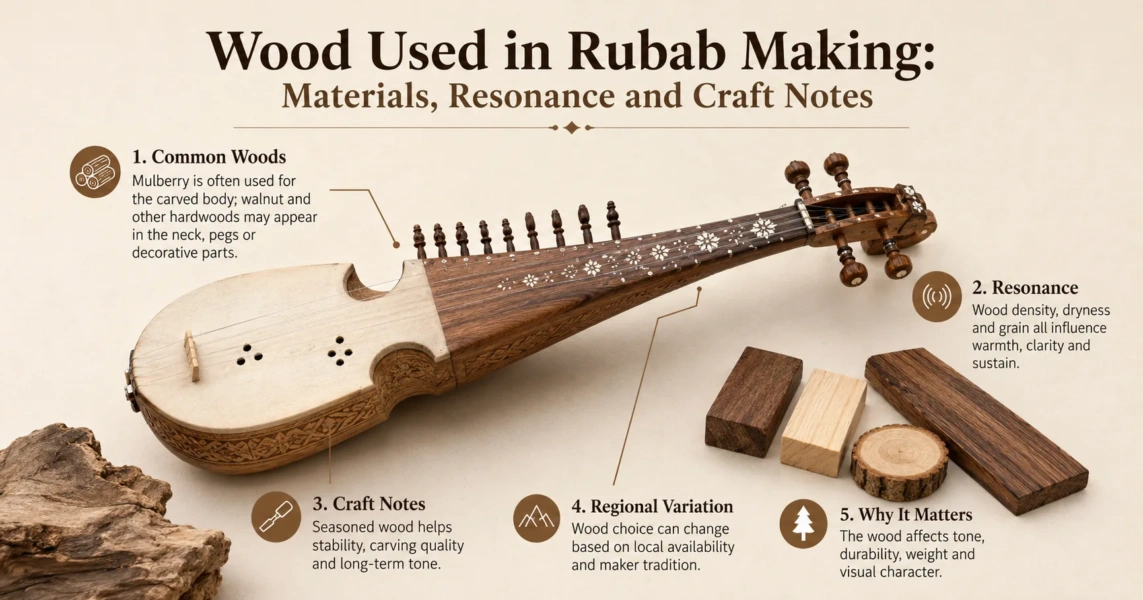
Wood used in rubab making is not only a matter of appearance. It affects weight, carving, neck stability, resonance, repair work, and the way an instrument ages under string tension. In regional rubab traditions, the choice of wood is also shaped by what makers can obtain locally, how the body is carved, whether the soundboard is skin or wood, and how the instrument is expected to speak in performance.
Why Wood Choice Matters in Rubab Making
The rubab is usually discussed as a plucked lute, but its material life is just as important as its musical identity. A maker must balance strength, resonance, workability, and tradition. A dense piece of wood can hold carving detail and support tension, but it may also add weight. A lighter piece can help the body respond quickly, but it must still remain stable enough for pegs, neck joints, and string pressure.
There is no single universal wood recipe for every rubab. Afghan rubabs, Central Asian rubobs, regional rababs, and related instruments may use different body forms, soundboard materials, peg systems, and decorative methods. For that reason, wood should be understood as part of a regional craft system, not as a fixed global standard.
Material Note: Wood choice can shape resonance, sustain, attack, and playing feel, but it does not act alone. Body depth, carving thickness, skin or wooden soundboard, bridge design, strings, setup, and the player’s technique all affect the final sound.
Common Woods Used for Rubab Bodies
Many rubab-family instruments use carved wooden bodies. The body may be hollowed from a single piece or built through joined parts, depending on the tradition and maker. Woods are often chosen because they can be carved cleanly, remain stable after seasoning, and produce a body strong enough to carry the instrument’s structure.
| Wood Type | Typical Use | Craft Reason | Sound Consideration |
|---|---|---|---|
| Mulberry | Body, bowl, or resonator in many regional lutes | Carves well when properly seasoned and has a long association with instrument making in parts of Asia | Often valued for a warm, responsive character, though results depend on construction |
| Walnut | Body, neck, pegs, and carved decorative areas | Strong, attractive, and suitable for detailed carving | Can support a firm, focused response when the body is well shaped |
| Apricot | Body or smaller carved parts in some regional craft contexts | Dense fruitwood with a fine texture | May give a compact, clear response, depending on thickness and setup |
| Plane or Sycamore-Type Woods | Body or structural parts where locally available | Workable and visually plain enough for carving or finishing | Used more for practical craft qualities than for one fixed tone identity |
| Softwoods | Wooden soundboards in some related lute traditions | Light, resonant, and easier to graduate thinly | Can support projection and quick vibration when used as a top plate |
This table should not be read as a strict rulebook. Local makers may use other woods when they are stable, seasoned, and suitable for the instrument’s form. In handmade traditions, the quality of the individual piece of wood often matters more than the name of the species.
Mulberry Wood and Its Place in Rubab Craft
Mulberry is one of the woods often associated with carved lutes across Central and South Asian instrument traditions. It is valued because it can produce a strong resonating body when selected and dried with care. In some workshop settings, its cultural familiarity matters as much as its acoustic behavior. Makers know how it cuts, how it hollows, and how it responds after shaping.
A rubab body made from mulberry may have a warm visual color and a practical balance between firmness and resonance. Still, not every mulberry body sounds the same. Age, grain direction, moisture content, carving depth, body size, and the soundboard all change the result.
Walnut, Fruitwoods and Carved Detail
Walnut is often admired for its strength and dark figure. It can be used for bodies, necks, pegboxes, tuning pegs, and carved ornamental sections. On instruments with visible carving, walnut gives the maker a surface that can hold detail without feeling brittle under the tool.
Fruitwoods such as apricot may appear in regional craft where they are available and well understood by local makers. These woods can be dense and fine-grained, which helps with clean carving. The tradeoff is weight. A maker must avoid leaving the body too heavy or too thick, especially on an instrument that depends on a lively resonator.
Body Wood vs Soundboard Material
The rubab’s body wood should not be confused with its soundboard material. In many Afghan rubab forms, the lower resonating area is covered with skin, while other parts may include wood. Related regional instruments may use different top structures. This changes how wood participates in the sound.
When a skin soundboard is used, the carved wooden body acts as the resonating chamber and structural shell. The skin, bridge, and strings drive much of the immediate vibration. The body wood still matters, but it works through chamber shape, stiffness, and mass rather than by vibrating like a thin wooden violin top.
When a wooden soundboard is used in a related lute form, the top plate becomes a more direct sound-producing surface. In that case, lighter resonant woods and careful thicknessing become especially important.
Luthier’s Note: A good rubab body is not judged only by species. Seasoning, grain, carving symmetry, wall thickness, neck alignment, and bridge placement can matter as much as the wood name.
Seasoning, Drying and Stability
Wood must be dried before it becomes part of a rubab. If it is carved too soon, the body may twist, crack, or move after the instrument is finished. Pegs may loosen, joints may open, and the top may stop fitting cleanly.
Seasoning also helps the maker judge the wood more accurately. Dry wood cuts differently from green wood. It gives clearer feedback under the tool and makes it easier to leave the body at a controlled thickness. This is especially important for a carved resonator, where a few millimeters can change weight and response.
Resonance and Sound Character
Wood does not create a rubab’s tone by itself. It helps shape the way energy moves through the instrument. A well-made body can support clarity, warmth, and projection. A poorly seasoned or overly thick body can feel muted, even if the wood species has a good reputation.
Several craft choices work together:
- Body depth: A deeper body may support a fuller low response, depending on the instrument form.
- Wall thickness: Thin carving can increase response, but the body must stay strong.
- Grain direction: Stable grain helps reduce warping and cracking.
- Bridge position: The bridge transfers string energy into the soundboard and body.
- Skin or wood top: The top material changes attack, sustain, and tonal color.
- String type and tension: Strings can make the same body feel brighter, softer, tighter, or more open.
Neck, Pegs and Structural Parts
The neck and pegbox need wood that can resist tension. These parts are not only decorative. They hold alignment, string angle, and tuning stability. If the wood is too soft or poorly fitted, pegs may slip and the instrument may become hard to tune.
Harder woods are often used for pegs because they must turn smoothly while gripping the pegbox. The fit between peg and hole is as important as the material itself. A beautiful peg made from unsuitable wood, or fitted badly, will still cause tuning problems.
Decoration, Inlay and Surface Finish
Many rubabs include carved decoration, inlay, edging, or contrasting materials. Wood choice affects how these details are made. Fine-grained woods hold crisp carving. Darker woods can show pale inlay clearly. Plainer woods may be chosen when the maker plans to cover parts of the surface with ornament.
Finish should protect the wood without choking the instrument. Heavy coatings can change how a thin or lightly carved part responds. Traditional finishes and modern finishes vary widely, so the safest rule is restraint: the finish should serve the instrument, not hide the craft.
Regional Differences in Wood Use
Rubab-family instruments developed across wide regions, and local materials shaped local craft. A maker in one area may have access to mulberry or walnut; another may work with fruitwoods, plane-type woods, or other stable local timber. Imported wood may also appear in modern workshop production.
Regional naming adds another layer. Rubab, rabab, rebab, rubob, rababa, and related spellings do not always describe the same construction. Some refer to plucked lutes, some to bowed instruments, and some to local forms with different bodies and soundboards. Wood choices must be read together with the exact instrument type.
How Makers Judge a Suitable Piece of Wood
A maker usually looks beyond species name. The chosen piece must be dry, stable, and free from defects that would weaken the body. It should have enough size for the intended form and enough strength around the neck joint, pegbox, and resonating chamber.
- Stability: The wood should not be likely to twist or split after carving.
- Workability: It should cut cleanly under chisels, gouges, and knives.
- Weight: The body should not become needlessly heavy.
- Grain: The grain should support the shape rather than fight it.
- Repair behavior: The wood should accept fitting, gluing, and future maintenance.
Common Misunderstandings About Rubab Wood
One common mistake is to treat one wood species as automatically superior. A fine instrument can be made from a well-chosen, well-seasoned piece of ordinary local wood. A poor instrument can be made from a famous wood if the carving, drying, and setup are careless.
Another misunderstanding is to assume that all rubabs use the same wood because they share a name. The rubab family is broad. Construction differs by region, and the same spelling can point to different instrument types in different contexts.
A third mistake is to separate material from musical use. A rubab made for strong ensemble projection may not be built exactly like one intended for intimate playing or decorative collection. The maker’s goal shapes the material decision.
Collector’s Note
When examining an older rubab, wood identification should be cautious. Color alone is not enough. Age, finish, smoke, repair work, staining, and polish can change the surface. Tool marks, grain, weight, peg wear, and internal carving may give better clues, but exact species identification often requires expert inspection.
Cracks are not always fatal, but their location matters. A repaired side crack may be less serious than damage around the neck joint, pegbox, bridge area, or soundboard edge. For playable instruments, structural condition matters more than decorative brightness.
What Wood Reveals About Craft
Wood used in rubab making reveals how practical the instrument is. It shows local supply, workshop habits, carving skill, and the maker’s idea of sound. The best material choice is rarely the most expensive one on paper. It is the piece that fits the body design, remains stable, supports the setup, and lets the instrument speak clearly.
For that reason, rubab wood should be described with care. Mulberry, walnut, fruitwoods, and other timbers all have places in the craft, but the finished instrument is the result of many joined decisions: wood, skin or top, bridge, strings, pegs, carving, finish, and use. The material is important because it works with all of them.