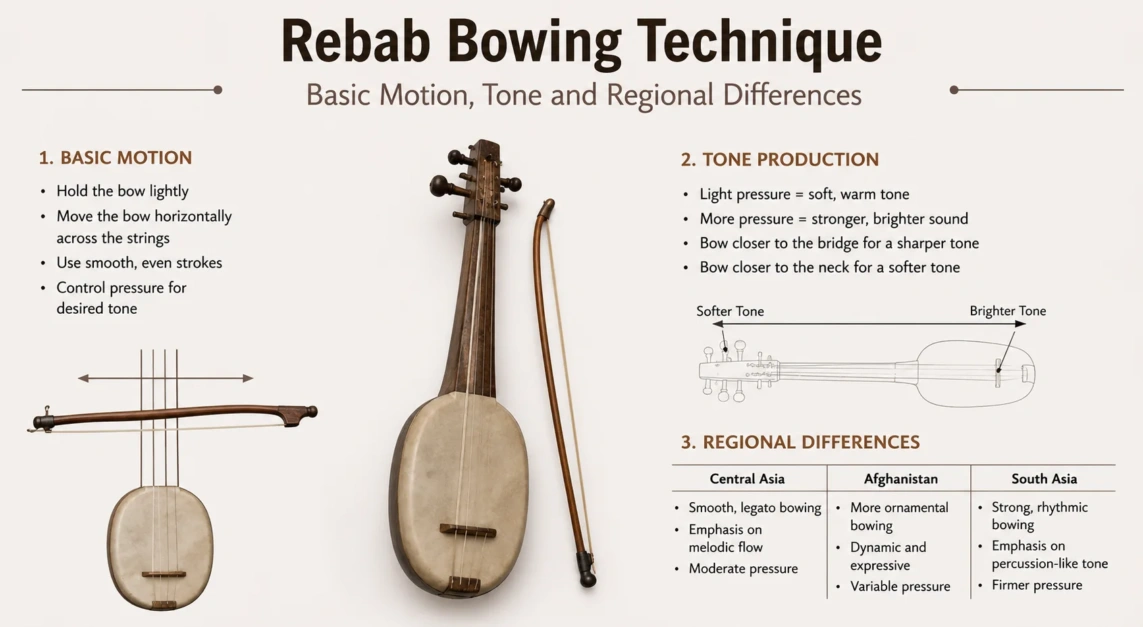
A rebab bow does more than keep a string vibrating. Its speed, hair tension, angle, and change of direction shape the start of each note, the continuity of a phrase, and the way the instrument sits inside a vocal or ensemble texture. The shared physical principle is friction, but rebab bowing technique is not one universal hand position. A Central Javanese rebab, a Sundanese rebab, a Malay rebab, a North African rabāb, and an Egyptian rabāba place the instrument and bow in different working relationships.
Scope of the technique: The instructions here apply to bowed rebab forms. Afghan rubab and several Punjabi or North Indian rabab traditions are plucked lutes, so their right-hand technique uses a plectrum or the fingers rather than a bow.
First Identify the Bowed Rebab Form
The name rebab covers several related chordophones rather than a single standardized instrument. Before copying a bow hold, identify how the instrument rests, how many strings the bow must reach, whether the hair is kept loose, and whether the body can rotate around a spike.
These construction details change the motion. A bow that feels natural on a cross-body North African rabāb may be awkward on an upright Javanese spike fiddle. The same warning applies in reverse.
| Regional Form | Typical Playing Position | Bowing Feature to Notice | Usual Musical Context |
|---|---|---|---|
| Sundanese rebab | Upright in front of a seated player | Long and short strokes support phrasing and ornament | Kliningan, celempungan, and related Sundanese settings |
| Central Javanese rebab | Upright with the lower foot supported on the floor | Loose bow hair may be tensioned by a finger while playing | Soft-style gamelan performance |
| Malay rebab | Vertical, often parallel with the torso | Grip, hair tension, stroke speed, and body rotation work together | Mak Yong and other Malay performance traditions |
| North African rabāb | Held across the body from knee toward shoulder | The stroke travels in a more horizontal plane | Vocal and ensemble accompaniment |
| Egyptian rabāba | Vertical with the spike supported below the resonator | The resonator may turn on the spike to improve bow access | Folk singing and narrative accompaniment |
Regional labels describe broad practices. Instrument makers, teachers, repertoires, and individual players may use different materials or slightly different hand positions within the same tradition.
Set the Instrument Before Setting the Bow
A stable rebab gives the bow a predictable surface. If the resonator rocks, the neck leans with every stroke, or the spike slips, the player must correct the instrument and the bow at the same time. That usually produces uneven contact.
Keep the Base Secure
For an upright spike fiddle, place the foot or spike where it can remain still without forcing the torso to twist. Depending on the form, it may rest on the floor, a support near the knee, or another traditional contact point. The neck should stay available to the left hand without being squeezed.
A cross-body rabāb needs a different balance. The instrument is supported between the lower body and shoulder area, allowing the bow to travel across a plane that is closer to horizontal.
Release the Shoulder
The bow arm needs room to change direction. Raising the shoulder makes the stroke heavy and short. Locking the wrist makes the reversal audible as a bump. A relaxed setup does not mean a loose, collapsing posture; it means that the instrument stays steady while the joints remain free.
- The torso stays quiet.
- The shoulder remains low.
- The wrist can adapt at the end of a stroke.
- The fingers hold or tension the bow without crushing it.
Luthier’s Note: Bowing problems can begin in the instrument. A leaning bridge, damaged membrane, poorly seated string, unstable spike, or badly prepared bow hair can make a controlled stroke sound rough. Technique should be assessed only after the working setup is sound.
Do Not Import a Violin Hold Without Testing It
A violin bow uses a screw-adjusted hair ribbon and a familiar overhand hold. Many rebab bows are more curved, simpler in construction, or kept with looser hair. Some players control the hair directly with a free finger. The hand therefore manages both movement and working tension.
Useful violin principles—steady contact, free joints, controlled speed—may transfer. The exact grip often does not.
The Basic Bowing Motion
The basic motion is a controlled pull-and-return cycle. Terms such as down-bow and up-bow can be misleading when the instrument is vertical or held across the body, so it is often clearer to think in terms of outward stroke and returning stroke.
Place the Hair Before Starting the Note
Set the bow hair on the selected string without dropping the hand onto it. Establish contact first, then begin moving. If pressure arrives before motion, the string may catch and release with a scratch. If motion begins before contact is secure, the attack may sound thin or breathy.
- Bring the bow to the string quietly.
- Feel a light, stable contact.
- Start the stroke without a sudden shove.
- Allow the sound to settle before changing direction.
Use a Chain of Small Movements
Long strokes usually need the forearm. The wrist and fingers refine the line, especially near a reversal. The upper arm may reposition the bow for another string, but large shoulder swings tend to disturb the angle.
Short strokes use less travel. The hand becomes more active, yet the movement should not shrink into a stiff wrist flick. The sound still needs enough hair movement to set the string in motion.
Change Direction Without Dropping the Tone
The end of a stroke is where many notes break. A smooth reversal has three parts: controlled deceleration, maintained contact, and a gentle start in the new direction.
Do not wait until the bow has fully stopped and then force it backward. Slow the hand near the end, let the wrist prepare the return, and reverse while the hair remains settled on the string. The sound may narrow slightly at the turning point, but it should not disappear unless the phrasing calls for a break.
Listening Note: Record one open string for four slow outward strokes and four returning strokes. If one direction is weaker, listen for a change in speed, angle, or hand tension. The two directions do not need to feel identical, but they should produce a comparable tone when the musical phrase asks for it.
Four Controls That Shape Rebab Tone
Rebab tone comes from several variables working at once. Treating the problem as “more pressure” or “less pressure” is too simple, especially on bows whose hair tension changes inside the hand.
Bow Speed
Speed affects how quickly the string is energized and how the sound continues. A slow stroke with heavy contact can choke the vibration. A fast stroke with weak contact can produce an airy edge. The usable range depends on the string material, membrane response, bridge, bow hair, and regional sound ideal.
For a beginner, the first aim is not maximum volume. It is an even sound that can be repeated.
Hair Tension and Contact Force
On a fixed-tension bow, the hand mainly controls the bow’s weight and its contact with the string. On a loose-haired rebab bow, a finger may also pull or release the hair. Those are separate actions.
- Too little working tension can make the hair skate or respond late.
- Too much working tension can make the stroke rigid and reduce the bow’s flexibility.
- Too much downward force can compress the sound even when the hair tension is correct.
The player should learn which variable changed. Tightening the hair is not always the same as pressing harder into the string.
Contact Point
The contact point is the place where the hair crosses the string between the bridge area and the upper part of the instrument. Moving nearer the bridge often asks for firmer control and can emphasize a more focused edge. Moving farther away can soften the response, but it may also weaken clarity.
There is no universal rebab measurement for this distance. A small bridge on a skin-covered resonator behaves differently from a violin bridge on an arched wooden body. Find a stable working zone on the actual instrument, then explore small changes.
Bow Angle
The bow should reach the chosen string without grazing a neighbor unless a double-string effect is intended. If the angle changes throughout the stroke, the tone can pulse or wobble even when the speed remains steady.
Watch the relationship between the bow stick, hair, string, and bridge. On some upright forms the instrument can rotate slightly, reducing the amount of arm movement needed to reach another string.
Long and Short Bow Strokes
Long and short strokes do different musical work. A long stroke supports continuity, vocal-like shaping, and sustained ornament. A short stroke can mark an accent, repeat a pitch, or separate notes within a more active phrase.
| Feature | Long Stroke | Short Stroke |
|---|---|---|
| Main use | Sustained line and broad phrasing | Articulation, accent, and repeated notes |
| Motion | More forearm travel with flexible wrist support | Smaller travel with more hand and finger control |
| Common problem | The bow runs out before the note ends | The attack becomes clipped or scratchy |
| Practice test | Keep one tone even across the full stroke | Repeat equal strokes without changing the angle |
Distribute the Bow Across the Note
Beginners often use too much bow at the start and have little room left for the end. Divide the motion mentally. A four-count note should not consume most of the stroke in the first count.
Short strokes present the opposite problem. They may be so small that the string never speaks clearly. Use less distance, not zero distance.
Let the Phrase Decide the Stroke Length
Regional technique links bow length to melodic grammar. A long note may need one uninterrupted stroke, two controlled strokes, or an internal articulation. The written duration alone does not decide. Vocal phrasing, ensemble structure, and ornament placement also matter.
String Crossing by Bow Angle or Instrument Rotation
There are two main ways to reach another string: change the bow angle, or turn the instrument toward the bow. Many players use a small amount of both.
Changing the Bow Angle
Lift or lower the working plane just enough to clear the neighboring string. The movement should come from a coordinated adjustment of forearm and hand, not a sudden elbow jump.
Practice the crossing without changing pitch first. Move from one open string to the next while keeping the bow hair in contact. The sound may pause during the earliest practice stage, but the angle should remain controlled.
Rotating the Instrument
Some spike-fiddle forms allow the body to rotate around its vertical axis. The Egyptian rabāba provides a clear structural example: its resonator can turn on the spike to make bow access easier. Malay rebab players may also use body rotation to touch a neighboring string for an embellishing sound.
The rotation should be small. If the entire neck swings, the left-hand pitch position changes and the bow must chase a moving target.
Sounding Two Strings
Several traditions use both strings together in selected places. This is not the same as accidentally hitting a second string. An intentional double-string stroke has a prepared angle, balanced contact, and a musical reason.
Regional Note: String crossing cannot be separated from construction. Bridge height, bridge curve, string spacing, and the width of the resonator determine how much bow angle is available.
Regional Differences in Rebab Bowing
The physics of bowed sound is shared, but each tradition organizes the stroke around its own repertoire. A regional bowing term usually describes musical behavior as well as hand motion. It should not be reduced to a shape copied in isolation.
Sundanese Rebab: Pedotan, Senggol, and Stroke Character
In Sundanese playing, the bow helps form pedotan, the division and breathing of a melodic line. It also supports senggol, the recognizable turn of phrase and ornamental character heard in rebab performance. Long and short strokes are therefore linked to melodic expression, not treated as neutral exercises.
Documented Sundanese terminology includes several bowing actions:
- Ligar sounds both open strings with a light, flowing stroke.
- Embat or golosor uses a slow stroke in one direction to carry one or more notes smoothly.
- Cacagan creates repeated, separated notes while the bow continues in one general direction and remains in contact with the string.
These labels describe more than length. They include pressure, continuity, note grouping, and placement inside the song. A player who produces a smooth sound but ignores the phrase may still miss the regional character.
A Useful Sundanese Practice Pattern
- Play one sustained note with a slow embat-like stroke.
- Repeat the same pitch with several short, equal articulations.
- Place the short articulations inside one longer directional motion.
- Apply the pattern to a phrase only after the tone stays controlled.
Central Javanese Rebab: Loose Hair and Structural Bow Direction
The Central Javanese rebab often uses a loose-haired bow. A free finger adjusts the hair while the stroke is moving, so the hand controls stroke direction, contact, and hair tension at the same time.
Bowing is also tied to the structure of the gendhing. Documented teaching places pulled strokes at selected metric and punctuating points, while named patterns organize how often the bow changes and how it anticipates a structural arrival.
Terms found in descriptions of Central Javanese practice include:
- Mbalung, where the bow rate follows the pulse of the balungan.
- Milah, where bowing follows aspects of the balungan pitch movement.
- Lombo, often described as two notes within one bow and used in melodic anticipation.
- Tikelan, a denser pattern with repeated strokes related to structural emphasis.
- Nduduk, a term applied to syncopated or hurried bow patterns in different descriptions.
Published accounts do not always define tikelan and nduduk in the same way. That disagreement matters. The term should be learned from a teacher together with a specific piece, tempo level, and regional school rather than memorized as a universal stroke.
The desired result is not a loud solo line. The rebab guides, anticipates, and colors the soft ensemble texture. Economy of movement helps it do that.
Malay Rebab: Grip Tension, Stroke Speed, and Body Rotation
The Malay rebab is commonly held upright and is closely associated with Mak Yong. Its three-string setup and curved bow ask the right hand to coordinate several actions: bow speed, hair tension, grip pressure, contact with the string, and small rotations of the instrument.
The bow can produce a continuous melodic line that supports vocal delivery and stage action. Shorter neighboring-string touches may serve as embellishment. A technique that works in an isolated scale can feel wrong when it ignores the singer’s timing or the dramatic movement.
Modern examples may use different string and bow-hair materials from older instruments. That changes response. Nylon line, horsehair, modern strings, traditional thread, and replaced bridge or membrane materials do not all react in the same way, so hand pressure should be adjusted by listening rather than copied as a fixed amount.
Material Note: A skin-covered soundboard responds to humidity, tension, bridge loading, and repairs. A bow that felt balanced on one day or one instrument may need a small change in speed or contact on another.
North African Rabāb: Cross-Body Bowing
Many documented North African rabābs are boat-shaped, two-string, fretless fiddles held across the player’s body. The pegbox rests near the shoulder while the lower end is supported near the opposite knee. This position turns the bowing line sideways compared with an upright spike fiddle.
The hand must follow that plane without twisting the wrist. The forearm travels across the instrument, and the support points help keep the body steady. Museum records describe this form mainly in relation to singing and ensemble accompaniment, so the stroke serves vocal phrasing rather than a modern solo-fiddle ideal.
A clear tone may still have a dry or nasal edge. That color should not be mistaken automatically for poor contact.
Egyptian Rabāba: Turning the Resonator Toward the Bow
The Egyptian rabāba is an upright spike fiddle documented with horsehair strings over a skin-covered coconut resonator. Because the resonator can turn on the spike, the player may bring a string toward the bow instead of making a wide arm movement.
This construction supports a compact gesture. It also suits accompaniment in which the instrument follows a singer or storyteller, matching the length, stress, and cadence of the vocal line.
Horsehair strings do not respond like smooth metal strings. The attack may sound textured, and the useful contact range can feel narrower. The aim is repeatable control within that sound, not imitation of an orchestral violin.
Balinese and Other Indonesian Contexts
Balinese rebab forms are also played upright in several gamelan settings, but their role, articulation, and ornament depend on the ensemble and repertoire. A general bow exercise can prepare the hand; it cannot replace local phrasing knowledge.
The same caution applies across Indonesia. Sunda, Central Java, East Java, and Bali share the rebab name while preserving different construction details, tonal expectations, and musical vocabularies.
Clean Control Is Not the Same as a Violin-Like Tone
A technically controlled rebab does not need to sound polished in the manner of a modern violin. Regional instruments may favor a focused nasal color, a dry attack, a textured sustain, or a narrow change in tone during ornament.
Control means that the sound is intentional and repeatable. It means the player can distinguish a chosen texture from accidental scraping, a planned double-string stroke from an uncontrolled collision, and a phrase break from a failed bow reversal.
| Heard Result | Likely Interpretation | What to Check |
|---|---|---|
| Dry but steady attack | May suit the instrument or regional style | Can it be repeated at the same dynamic? |
| Scratch before every note | Usually an unbalanced start | Contact before motion, then speed |
| Nasal, focused sustain | May be a normal membrane-and-string color | Is the pitch and bow line stable? |
| Random burst on a second string | Unplanned angle change | Bridge clearance and instrument rotation |
| Short break at every reversal | Late preparation of the return stroke | Deceleration and wrist release |
Diagnosing Common Bowing Problems
Listen to the symptom first. Then change one variable at a time. Changing speed, tension, angle, and posture together makes the cause harder to find.
| Problem | Possible Cause | Simple Test | Adjustment |
|---|---|---|---|
| Scratchy start | Heavy contact before the bow moves | Begin with less force on an open string | Set the hair, then start the stroke |
| Airy or weak tone | Unstable hair contact or excessive speed | Use a shorter, slower stroke | Stabilize contact before adding length |
| Tone collapses mid-stroke | Speed falls or the hair loosens | Divide the stroke into four equal counts | Keep the motion and working tension even |
| One direction sounds weaker | Grip changes during the return | Alternate strokes on one open string | Compare wrist position and hair tension |
| Neighboring string sounds | Angle drifts or the body rotates too far | Cross strings in slow motion | Reduce the size of the angle change |
| Bow feels stuck | Too much force, too much rosin, or poor setup | Try lighter contact after checking the hair | Correct the setup before forcing the stroke |
| Pitch wavers during bowing | The instrument or left hand moves with the bow | Sustain one stopped note at low volume | Stabilize the base and separate arm tasks |
Coordinating the Bow with the Left Hand
The rebab is usually fretless, and many forms do not use a fingerboard in the violin sense. The left hand stops or touches the string while the bow continues to supply energy. If the two hands change at different times, the pitch may smear or the note may lose its center.
Separate the Tasks First
Practice a stable open string before adding left-hand motion. Then hold one stopped pitch while repeating slow bow changes. Only after the tone remains steady should the finger move between pitches.
Do Not Press Harder Because the Bow Is Weak
A thin bow tone often causes the left hand to squeeze. That does not solve the right-hand problem and may pull the pitch out of place. Keep the finger pressure suitable for the instrument while correcting bow contact separately.
Place Ornament Inside the Bow Phrase
Glides, pressure changes, vibrato-like movements, and regional ornaments need a stable flow of sound. The left hand shapes pitch while the bow decides whether the gesture sounds connected, accented, delayed, or cut short.
On the Sundanese rebab, ornament and bow phrase are closely linked. On the Central Javanese rebab, bow patterns also relate to ensemble structure. In both cases, learning the left-hand shape alone leaves the musical action incomplete.
A Progressive Rebab Bowing Practice Sequence
Practice should move from stable motion to regional phrasing. The sequence below avoids fixed pressure values or bow distances because instruments differ too much for one measurement to be reliable.
Stage 1: Silent Bow Path
- Move the bow above the string without contact.
- Keep the shoulder low and the instrument still.
- Check that the return follows the same general plane.
- Practice a small string-crossing angle.
Stage 2: One Open String
- Place the hair before moving.
- Use four counts outward and four counts back.
- Keep the tone level through the middle of the stroke.
- Reduce any gap at the reversal.
Stage 3: Contact Experiments
Play the same note several times, changing only one item:
- slightly faster or slower stroke;
- slightly firmer or lighter contact;
- slightly more or less hair tension, where the bow permits it;
- a small shift in contact point.
Listen for the effect. Do not label the loudest result as the best one.
Stage 4: Long and Short Strokes
- Two long strokes.
- Four short strokes.
- One long stroke followed by two short strokes.
- Two short strokes followed by one long stroke.
Keep the contact point stable while the stroke length changes.
Stage 5: String Crossing
Move between neighboring strings without changing the bow direction. Then repeat while changing direction at a different moment. Separating these actions prevents the elbow, wrist, and instrument rotation from collapsing into one uncontrolled gesture.
Stage 6: Regional Phrase Work
Choose a short phrase from the tradition of the instrument. Mark where the bow changes, where it continues across several notes, where it touches another string, and where the phrase breathes. Repeat the phrase slowly without removing its stroke pattern.
A 15-Minute Bowing Routine
| Time | Exercise | Listening Focus |
|---|---|---|
| 2 minutes | Silent bow path and posture | Low shoulder, still instrument |
| 3 minutes | Long open-string strokes | Even sound in both directions |
| 3 minutes | Direction changes | No unintended gap or bump |
| 2 minutes | Short strokes | Equal attack and stable angle |
| 2 minutes | String crossing | No accidental second string |
| 3 minutes | One regional phrase | Stroke pattern supports the music |
Record the Same Test Each Week
Use one open string, one stopped note, one string crossing, and one short phrase. Keeping the test material unchanged makes progress easier to hear.
- Does the note begin before the scrape?
- Do both bow directions carry a similar tone?
- Does the sound weaken halfway through?
- Is the reversal intentional?
- Can the regional stroke pattern be heard without visual explanation?
Care Details That Affect Bowing Feel
Technique cannot compensate for every maintenance problem. Bow hair needs enough friction to grip the string, but excess rosin can create dust, noise, and a sticky response. Traditional bows without screw tension also need their hair to be stored and handled without being forced into a permanent high-tension shape.
Check the Bow
- Hair should be clean enough to take rosin evenly.
- Broken or twisted hair should not pull the working ribbon to one side.
- The stick should not be forced beyond its intended curve.
- A loose-hair design should remain loose when it is not being controlled by the hand.
Check the Instrument
- The bridge should stand in its intended position.
- The membrane should not show a new tear or severe slackness.
- Strings should pass over the bridge without slipping sideways.
- The spike or support point should remain stable during a full stroke.
Luthier’s Note: Do not reshape a traditional bridge, tighten a skin membrane, replace a string material, or alter a bow curve solely to make the instrument behave like a violin. These parts belong to the instrument’s regional design and should be assessed by someone familiar with that form.
How Bowing Motion Is Being Documented Today
Recent experimental work on an augmented Malay e-Rebab has treated bowing as measurable gesture. Sensors have been used to track stroke speed, bow-hair tension, grip pressure, and movement of the instrument body. This type of research can help document how several actions combine during a stroke.
The measurements do not create one correct rebab technique. They show why a simple instruction such as “press harder” is incomplete. A performer may alter speed, hair tension, grip, contact, and rotation in different proportions while producing a related musical result.
Digital tracking may support analysis and teaching, but regional phrasing still depends on listening, repertoire knowledge, and direct study with an experienced player.
Frequently Asked Questions
Does Every Rebab Use a Bow?
No. The name family includes bowed fiddles and plucked lutes. Afghan rubab and several related rabab forms are plucked, while Sundanese, Javanese, Malay, North African, and Egyptian examples discussed here are bowed.
Should a Rebab Bow Be Tight Like a Violin Bow?
Not always. Some rebab bows use loose hair that the player tensions with a finger during the stroke. Others use different bow constructions. The correct working tension depends on the regional bow and should not be judged by violin setup alone.
Why Does My Rebab Sound Scratchy at the Start of a Note?
The bow may be pressing into the string before it begins moving, or the contact may be unstable. Place the hair first, reduce excess force, and start with a controlled motion. Also check rosin, bow hair, bridge position, and the condition of the membrane.
Is a Smooth Tone Always the Best Rebab Tone?
No. Some traditions favor a dry, nasal, focused, or textured color. The test is whether the sound is intended, repeatable, and suited to the repertoire—not whether it copies a modern violin.
Should the Bow Move to Change Strings, or Should the Rebab Turn?
Both methods are used. Some forms rely mainly on bow-angle changes, while spike fiddles may allow a small rotation of the instrument. Egyptian and Malay examples show how body rotation can help the bow reach another string. The movement should remain small enough to preserve left-hand pitch control.
Can Rebab Bowing Be Learned Without a Teacher?
Basic tone exercises can be practiced independently, but regional bow direction, named strokes, ornament placement, and phrase timing are difficult to learn from hand motion alone. Recordings and written descriptions help, yet direct correction from a player familiar with the specific rebab tradition remains the safest way to avoid importing the wrong technique.