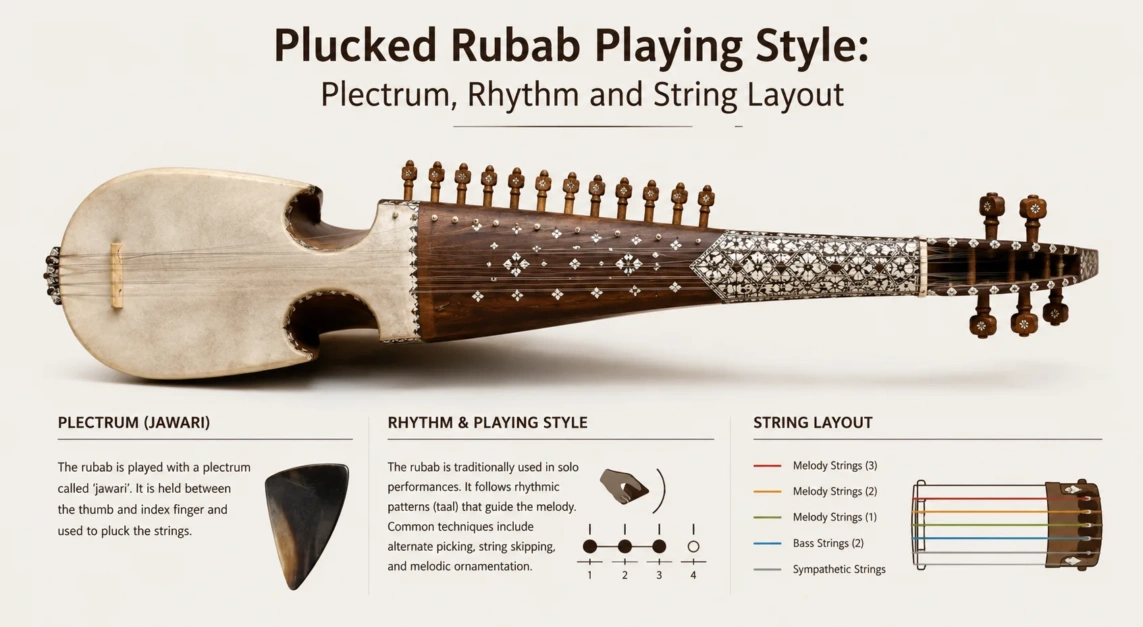
The plucked Afghan rubab produces rhythm before any drum enters. A downward plectrum stroke carries more weight than the return stroke, the skin-covered soundboard can add a dry percussive edge, and the player can move between melody strings, long drones, and a raised high drone without leaving the same compact right-hand area. The result is not simply a sequence of picked notes. It is a layered playing style in which attack, pulse, drone, and sympathetic resonance are shaped together.
The term rubab covers several related instruments, and spellings such as rabab, rubāb, robab, and rebab do not always describe the same construction. The technique discussed here belongs mainly to the Afghan or Kabuli rubab: a short-necked, double-chambered lute played with a plectrum and fitted with several distinct groups of strings.
Instrument Scope: Bowed rebabs, Pamiri rubabs, Kashgar rawaps, and other regional relatives have different bodies, string systems, and hand movements. Their playing methods should not be treated as interchangeable with Afghan rubab technique.
How the Instrument Turns One Stroke into Several Sounds
A rubab note begins with a firm plectrum attack, but the sound does not end at the struck string. The bridge transfers the vibration to a skin membrane stretched across the lower chamber. Metal sympathetic strings may then respond to matching pitches and overtones. A long drone or raised high drone can add another directly struck layer.
This creates three audible stages:
- Attack: the immediate sound of the plectrum releasing a melody string.
- Body response: the skin membrane and carved chamber reinforce the short, lively pulse.
- Resonant tail: sympathetic strings continue vibrating after the main note begins to decay.
The balance among these stages changes with the player’s touch. A forceful downward stroke can stress attack and percussion. A lighter stroke followed by a pause gives the resonant strings more room to be heard.
String Layout and Playing Function
Documented Afghan rubabs commonly have three main melody strings, two or three long drone strings, and a set of metal sympathetic strings. Some instruments carry as many as fifteen sympathetic strings, though the exact total varies with the size, maker, period, and intended repertoire.
The groups should be understood by function rather than by string count alone.
| String Group | Typical Arrangement | How It Sounds | How It Is Used |
|---|---|---|---|
| Main melody strings | Usually three thicker strings | Rounded body with a clear plectrum attack | Carry the melodic line, ornaments, repeated strokes, and cadential figures |
| Long drone strings | Often two or three strings beside the main set | Open, steady pitches with a more metallic edge | Mark tonal centers, strengthen accents, and widen selected downstrokes |
| Sympathetic strings | A variable group of thin metal strings | Soft ringing response beneath the played note | Reinforce pitches associated with the melodic mode |
| Raised high drone | The shortest sympathetic string on certain bridge layouts | Short, bright, repeating tone | Forms rhythmic patterns with the melody strings in parandkari |
String-Layout Note: A drone string and a sympathetic string do not perform the same task. A drone is deliberately struck. A sympathetic string normally sounds because another string produces a matching or closely related frequency. The raised high drone is unusual because a string from the sympathetic group is made accessible for direct rhythmic use.
The Three Main Melody Strings
The three main strings form the center of the playing surface. They are thicker than the sympathetic strings and are usually made from nylon on modern instruments. Earlier examples could use gut. Their relative thickness supports a low, middle, and high register rather than three identical strings.
Names vary by language and teaching tradition. In one documented Dari terminology, the lower string is called bam, the middle string miana, and the upper string jelau. Other players may use different spellings or regional names.
The main strings are often described as being tuned in fourths, but a fixed set of absolute pitches should not be assumed. Players choose a pitch level and modal arrangement that suit the instrument, voice, ensemble, and repertory. Detailed tuning belongs to its own technical treatment; for playing style, the more important point is that the three strings create a tiered field of notes.
The Long Drone Strings
The long drones run from the lower string holder toward pegs in or near the pegbox. They sit beside the melody strings and can be caught by a broad downward motion. A player may strike one deliberately, combine it with a melody-string stroke, or use it near the end of a phrase.
A drone does more than hold a background pitch. Its timing can announce a return, strengthen a beat, or make a melodic cadence feel settled. When a downstroke brushes a melody string and an adjacent drone together, the stroke gains both tonal weight and rhythmic width.
The Sympathetic String Bank
The sympathetic strings are thin metal strings that pass across the bridge and along the side of the neck. They are tuned in relation to the melodic material being performed. When a main string produces a suitable pitch, one or more sympathetic strings begin to vibrate without being directly picked.
The response is selective. Not every sympathetic string rings equally after every note. Matching pitches respond more readily, while nearby frequencies may contribute weaker overtones. The result is a changing field of resonance rather than a constant wash at one volume.
The Raised High Drone
On a bridge arranged for this technique, the shortest sympathetic string is raised above its neighbors by a small projection. This string is often called sim-e barchak in Dari terminology. The raised position lets the plectrum strike it separately from the rest of the sympathetic bank.
Its pitch is bright and brief. Because the same tone can be inserted repeatedly between melody-string strokes, it acts almost like a second rhythmic voice under the right hand.
The Rubab Plectrum
The Afghan rubab is played with a firm plectrum commonly called a shahbaz. The Persian-derived term mezrab may also be encountered. Historical and present-day plectrums vary in size, thickness, contour, and material, so there is no single shape that defines correct rubab playing.
Documented traditional materials include:
- Wood, which can be carved into a thick and rigid form.
- Horn, valued for its firmness and smooth working edge.
- Bone, used for a hard, durable striking surface.
- Modern synthetic material, including thick commercial picks adopted by some players.
A thin flexible guitar pick often feels unstable against the rubab’s heavier melody strings. The rubab plectrum needs enough stiffness to release the string clearly without folding away from it. This does not mean that the pick must be large or heavy. The working edge, grip, and angle matter as much as thickness.
Grip Between Thumb and Index Finger
The plectrum is held between the thumb and index finger. Only enough of the tip should extend beyond the fingers to clear the string. Too much exposed material can flex, rotate, or travel too deeply between the strings. Too little can bring the fingertips into unwanted contact with the playing surface.
Grip pressure should keep the plectrum stable while allowing the wrist to move. A loose grip may let it turn after a strong downstroke. An overly tight grip can stiffen the thumb, forearm, and wrist, making the return stroke slower than it needs to be.
| Grip Condition | Likely Result | What the Player May Notice |
|---|---|---|
| Too loose | Soft but uncertain attack | The plectrum shifts, twists, or begins to leave the fingers |
| Controlled and relaxed | Clear attack with an easy return | The tip stays aligned while the wrist remains mobile |
| Too tight | Hard, restricted stroke | Fatigue, uneven speed, and a tendency to catch between strings |
Contact Angle
The plectrum does not need to meet the string with its full face. A slight angle lets the edge pass across the string with less resistance. If it approaches too flatly and too deeply, the string can hold the pick for a fraction of a second before releasing it. That delay becomes obvious during fast repeated patterns.
A very steep angle produces a thin scraping sound and may reduce the full body of the note. The useful angle is therefore neither flat nor sharply turned. It allows a clear release while keeping the stroke connected to the weight of the hand.
Luthier’s Note: Plectrum response depends partly on string diameter, string material, bridge height, and playing tension. A pick that works well on one rubab may feel too soft, too sharp, or too deep on another.
Right-Hand Position and Wrist Angle
Traditional Afghan rubab technique uses a distinctly flexed right wrist. The hand approaches the strings from above and slightly forward rather than lying flat across them. This position helps the player reach the melody strings, adjacent drones, and raised high drone with short changes of direction.
The instrument is commonly supported so that the narrow waist between its two chambers rests near the right thigh. The body faces partly forward rather than lying fully across the player. This orientation brings the lower skin-covered chamber beneath the downstroke and places the string groups within a compact arc of movement.
The visible wrist bend should not be copied as a forced pose. Instrument size, arm length, seating position, and the angle of the body all change how much flexion is needed. A working position keeps the plectrum aligned while avoiding pain, numbness, or unnecessary pressure against the rim of the instrument.
Why the Downstroke Feels Heavier
A rubab downstroke moves toward the skin membrane. The hand has more distance to travel, and the weight of the hand supports the motion. This gives the stroke a stronger attack than the return movement.
On the lower and middle melody strings, the plectrum can use a controlled rest-stroke action. After releasing one string, it comes to rest against the neighboring string. This stops the pick from falling too deeply into the instrument and prepares the hand for the next movement.
The highest melody string requires more restraint because there is no equivalent melody string beneath it in the same direction. The plectrum should release the string without being driven into the skin.
Why the Upstroke Sounds Different
The upstroke travels against the direction of the weighted downward motion. It usually covers less distance and does not receive the same support from the hand. Its attack is therefore often lighter and narrower.
This difference is not merely a problem to correct. Afghan rubab players use it to shape rhythm. Changing the order of downstrokes and upstrokes changes the pattern of strong and light attacks even when the written note values remain equal.
Listening Note: In a clear solo recording, follow the first instant of each note rather than the pitch alone. A stronger, rounder attack often marks a downstroke. A smaller and quicker reply often comes from an upstroke.
Skin Contact and the Percussive Edge
The lower chamber of the Afghan rubab is covered with skin rather than a rigid wooden soundboard. In some right-hand styles, part of the hand touches this membrane during a downstroke. The contact adds a dry impact beside the string sound.
The amount of contact is not fixed. A player can allow a clear hand-to-skin impact, reduce it to a light touch, or curl the unused fingers away from the membrane. Each choice changes the relationship between string attack and body resonance.
- Heavier contact gives the pulse a stronger percussive edge but can momentarily restrict the membrane.
- Light contact keeps some physical punctuation while letting the skin move more freely.
- No contact separates the plectrum attack from hand percussion and can produce a more open ring.
This is one reason two rubab players can use the same melody and still sound quite different. One may treat the skin impact as part of the groove. Another may keep the hand clear and let the membrane respond without interruption.
From Stroke Direction to Rhythm
Rubab rhythm is partly encoded in the movement of the plectrum. The player does not need to change pitch to create a new rhythmic surface. Reordering strong downstrokes, lighter upstrokes, drone contacts, and rests can alter the feel of a repeated phrase.
A simple notation can help describe the motion:
- D — downstroke on a melody string
- U — upstroke on a melody string
- H — stroke on the raised high drone
- R — rest or sustained space
- > — accented stroke
The letters describe movement, not a full musical transcription. They do not show pitch, ornament, mode, or exact duration.
| Sequence | Movement | Audible Effect |
|---|---|---|
| D U D U | Regular alternation | Even forward motion with natural strong-light contrast |
| D U D D | Alternation followed by two downstrokes | A heavier close and a stronger return into the next cycle |
| >D U R U | Accented start with open space | A broad first pulse followed by a lighter reply |
| D H U H | Melody and high-drone exchange | Two alternating tone colors within one right-hand cycle |
| D U D H | Three melody strokes followed by high drone | A bright marker at the end of the unit |
These sequences are movement examples, not universal compositions. Traditional patterns depend on genre, tempo, regional practice, and the vocabulary of a particular teacher.
Shahbaz as Plectrum and Pattern
Shahbaz commonly names the plectrum itself. In one documented Afghan rubab teaching vocabulary, the same word is also used for a repeated right-hand pattern performed on the melody strings. The double use can confuse readers who expect one term to identify only one object.
A basic alternating pattern may be represented as D U D U. Some teaching notation records downstroke and upstroke with different letters, such as V and A. The symbols matter less than the physical distinction: the downward and upward movements do not produce identical attacks.
Accent Without Changing the Note
Repeating one note with D U D U does not produce four perfectly equal sounds. The downstrokes tend to carry more body. If the player changes the sequence to D U D D, the repeated downward motion redistributes the accents.
This allows a rubab player to reshape the micro-rhythm of a phrase while keeping its pitch outline intact. The listener may hear a fresh pattern even though the left hand has changed very little.
Parandkari and the High Drone
Parandkari is a right-hand practice in which the raised high drone joins patterns played on the main melody strings. A pattern that includes this drone may be called a parand.
The plectrum travels between two distinct sound areas:
- The thicker melody strings produce the changing musical line.
- The raised high drone returns with the same bright pitch.
The repeated drone can fall between melody attacks, answer an accented stroke, or appear several times within a longer cycle. Because the high drone remains stable while the melody moves, it gives the ear a second layer to follow.
Why the Raised String Matters
A normal sympathetic string sits too low and too close to its neighbors for fast isolated picking. Raising the shortest string solves a physical problem. The plectrum can reach it without sweeping across the entire sympathetic bank.
The modification turns string layout into technique. Without the raised bridge point, the same rapid exchange between melody and high drone would be less precise.
How Parandkari Creates Rhythmic Density
A melody-only cycle may contain four audible attacks. Inserting the high drone between selected strokes increases the number of attacks without requiring the left hand to add more notes. The right hand becomes busier while the melodic shape remains recognizable.
The player can then alter:
- how often the high drone appears;
- whether it follows a downstroke or an upstroke;
- whether several drone strokes occur together;
- where the pattern returns to the melody strings;
- how the density grows across repeated cycles.
In extended instrumental performance, a player may begin with a relatively open pattern and add more high-drone activity over successive repetitions. Tempo can also rise, though density and speed are separate choices. More strokes do not always require a faster underlying pulse.
Technique Note: Parandkari does not mean strumming every sympathetic string. It depends on controlled access to the raised high drone while the remaining sympathetic strings continue their resonant role.
Rhythm Before Tabla Accompaniment
Tabla can clarify the metric cycle and engage the rubab in rhythmic exchange, but the rubab does not depend on a drum to establish pulse. Its right hand already contains several rhythm-producing resources.
Alternating Attack
The contrast between downward and upward strokes creates a repeating strong-light relationship. Even a plain alternation can establish motion.
Drone Placement
A long or high drone can mark a selected beat without changing the main melody. Its contrasting pitch makes the accent easy to hear.
Stroke Density
The player may place more attacks within the same span of time. Tremolo-like movement, repeated downstrokes, and high-drone insertions can all thicken the surface.
Cadential Figures
Phrase endings can be marked by a burst of repeated strokes, a broader drone contact, or a short rhythmic figure. Such endings help divide a long instrumental performance into audible episodes.
Skin Percussion
Controlled contact with the membrane can reinforce the downward pulse. The rubab then produces string tone and a soft body impact within the same hand movement.
These elements explain why an unaccompanied rubab performance can feel rhythmically complete. The instrument carries melody and pulse without turning into a percussion instrument in the usual sense.
Free Rhythm and Measured Playing
The right hand behaves differently in a free-rhythm introduction than in a measured section. Treating both with the same continuous picking pattern would hide an important part of rubab expression.
Free-Rhythm Passages
In a slow introductory passage, individual notes may be allowed to expand. The player can pause after a stroke and let the sympathetic response become audible. Silence separates phrases and gives the skin-covered chamber time to release its sound.
A downward sweep across several sympathetic strings may be used as punctuation. This produces a cluster of open resonance rather than a normal melodic chord. Such a sweep is more effective when it is occasional; constant use would blur the difference between played notes and resonant color.
Measured Sections
Once a regular cycle begins, the right hand moves more continuously. Downstrokes and upstrokes establish the pulse, while drones and cadential patterns mark larger divisions. Parandkari can add further motion by inserting the raised high drone between melody attacks.
| Playing Element | Free Rhythm | Measured Playing |
|---|---|---|
| Stroke spacing | Flexible, with long pauses possible | Related to a steady pulse or metric cycle |
| Sympathetic resonance | Often exposed and easy to hear | Blends beneath repeated attacks |
| Drone use | Phrase punctuation and tonal reference | Accent, cycle marking, and pattern formation |
| Plectrum motion | Selective and spacious | Repeated, patterned, and often denser |
| Skin contact | May be reduced for an open decay | Can reinforce the regular downward pulse |
The Left Hand and the Tiered Note Layout
Although rubab rhythm is strongly associated with the right hand, its patterns are shaped by the left-hand layout. Notes are distributed across three main strings rather than arranged as one continuous row along a single string.
This has been described as a tiered array. A melody can move in two directions at once:
- along the neck, from one fret position to another;
- across the strings, from a lower or middle string to a higher one.
The right hand must follow each string change. A phrase that crosses repeatedly between strings may call for a different stroke order from a phrase lying mostly on one string. The most comfortable plectrum sequence is therefore tied to the location of the notes.
Four Frets and the Upper Unfretted Area
Many traditional Afghan rubabs have four tied frets across the wooden upper soundboard. These give a practical fretted range while leaving the higher part of the string unfretted. Skilled players can stop notes above the last fret directly against the fingerboard, though control becomes more demanding.
Modern instruments may depart from this arrangement. Some use extended or fixed fret systems to make higher notes easier to locate. Such changes affect fingering and range, but they do not erase the instrument’s three-string tiered structure.
Hammer, Pull, and Damped Ornament
The left hand can create more than one pitch from a single plectrum attack. A finger may strike the string onto a higher fret to form a hammer, or release it with a slight sideways action to form a pull. A lighter touch can hint at an upper pitch without allowing it to speak fully.
These ornaments reduce the need to pick every note. The right hand can maintain a broader rhythmic pattern while the left hand supplies smaller melodic movements inside it.
How String Choice Changes a Phrase
The same melodic idea can take on a different shape depending on which string groups the player includes.
Melody Strings Alone
Using only the main strings gives the phrase a direct outline. The listener hears the contrast between downstroke and upstroke clearly, with fewer open pitches around the melody.
Melody with a Long Drone
Adding a long drone strengthens the tonal reference. It can make the first beat feel broader or give the last stroke of a phrase a settled quality.
Melody with the Raised High Drone
Alternating with the high drone introduces a bright recurring voice. The melodic notes may move, but the high tone keeps returning at selected rhythmic points.
Melody Followed by a Sympathetic Sweep
A sweep across several sympathetic strings creates a resonant boundary between phrases. It does not serve the same purpose as a long drone, since several pitches sound together and decay as a cluster.
Listening Note: When a repeated high pitch is as rhythmically clear as the melody, it may be the raised high drone. When a softer collection of pitches seems to appear after the note, it is more likely the sympathetic bank responding or being swept.
Sympathetic Resonance and Note Clarity
Sympathetic resonance gives the Afghan rubab much of its recognizable depth, but more ringing is not always better. In slow playing, the resonant tail can surround each note. In rapid passages, several responses may overlap and soften the edges between attacks.
The player manages this balance through touch and timing rather than through a single damping system.
- A firm, short attack keeps the beginning of a fast note clear.
- A small pause allows the resonant response to emerge.
- A change of string alters which sympathetic pitches respond most readily.
- A drone stroke can restore the tonal center after a dense passage.
- A sympathetic sweep deliberately favors resonance over separation.
The sympathetic strings need to be tuned for the music being played. Poorly matched strings may respond weakly or add pitches that cloud the mode. Their adjustment is part of preparation, even though they are not picked as ordinary melody strings.
How the Player Shapes Tone
The rubab does not have one fixed attack. Small physical changes alter the balance between sharpness, body, percussion, and ringing decay.
| Playing Choice | Likely Effect |
|---|---|
| Stroke closer to the bridge | More focused attack with less soft movement in the string |
| Stroke farther from the bridge | Rounder release and a broader string movement |
| More plectrum depth | Stronger attack, with a greater risk of catching the string |
| Less plectrum depth | Quicker release and easier rapid alternation |
| Greater hand contact with the skin | More percussive punctuation and less uninterrupted membrane movement |
| Hand kept clear of the skin | Cleaner separation between plectrum attack and body resonance |
| Drone added to a downstroke | Wider tonal accent and stronger sense of arrival |
| Pause after a note | More exposed sympathetic decay |
Instrument construction also affects the result. Skin tension, bridge fit, chamber dimensions, string material, and the condition of the tuning pegs all influence playing response. Wood choice can shape resonance, but the finished instrument depends on the whole relationship among carved body, membrane, bridge, and strings.
Playing Style Is Not Fully Standardized
Afghan rubabs differ in size, string count, bridge arrangement, plectrum preference, and setup. Players also learn through different regional and family traditions. One description should therefore not be treated as a universal rule for every rubab performance.
Variation appears in several areas:
- the amount of wrist flexion;
- the size and material of the plectrum;
- the strength of skin contact;
- the number and tuning of long drones;
- the number of sympathetic strings;
- the accessibility of the high drone;
- the use of repeated downstrokes;
- the balance between fretted and unfretted playing;
- the density of parandkari patterns.
A regional folk performance may favor a strong, driving right hand. A slow instrumental introduction may expose more resonance and silence. Vocal accompaniment may use fewer dense figures so that the singer remains clear. Advanced solo performance can move among all these approaches.
How It Differs from Other Rubab and Rebab Forms
The names rubab and rebab belong to a broad and historically connected instrument vocabulary. Similar spelling does not guarantee similar technique.
| Instrument Form | Primary Sound Method | Difference from Afghan Rubab Technique |
|---|---|---|
| Afghan or Kabuli rubab | Plucked with a firm plectrum | Uses three melody strings, drones, sympathetic strings, and patterned right-hand strokes |
| Bowed rebab forms | Sounded with a bow | Depend on bow pressure and direction rather than plectrum attack |
| Pamiri rubab | Plucked regional lute | Has its own body, neck, string arrangement, and repertory |
| Rawap or rewap forms | Plucked with regional plectrum methods | Longer-necked construction changes hand position and string access |
| Sarod | Plucked with a plectrum | Uses a metal-covered fretless fingerboard and a different left-hand technique |
The Afghan rubab and sarod share historical and structural connections, but their playing surfaces differ sharply. The rubab uses tied frets on its upper wooden section, while the sarod uses a smooth metal fingerboard. The sarod player stops the string with the edge of the fingernail, whereas rubab fingering is based mainly on pressing the string at or beyond fret positions.
What to Hear in a Rubab Performance
A plucked rubab performance becomes easier to understand when the sound is separated into several listening layers.
Follow the Attack
Listen for the first instant of each note. A broad attack often reflects a weighted downstroke. A lighter response may come from the return stroke.
Find the Repeating Drone
A directly struck drone is clearer and more rhythmically placed than sympathetic resonance. If a bright pitch keeps returning between melody notes, it may be the high drone used in parandkari.
Notice the Sound After the Note
The sympathetic strings are easiest to hear when the player leaves space. Their response sits behind the main note and may continue after the melody string has begun to fade.
Listen for Changes in Density
A player may repeat the same melodic section while adding more plectrum strokes. The section then feels more active even if its tonal outline remains stable.
Mark the Cadence
Listen for repeated strokes, a wider drone contact, or a short burst near the end of a phrase. These movements often signal a boundary before the player returns to the main pattern.
Separate Tabla Pulse from Rubab Pulse
When tabla is present, follow the rubab alone for several seconds. Its own accents may reinforce the drum cycle, answer it, or place smaller figures inside it.
Cultural Heritage Note: The art of crafting and playing rubab or rabab was inscribed in 2024 on UNESCO’s Representative List of the Intangible Cultural Heritage of Humanity through a joint nomination by Afghanistan, Iran, Tajikistan, and Uzbekistan. The inscription covers a wider family of practices than the Afghan plectrum technique described here.
Frequently Asked Questions
Is the plucked rubab played with a guitar pick?
It can be played with a thick synthetic pick, and some players use commercial guitar plectrums. Traditional plectrums may be made from wood, horn, or bone. A thin flexible guitar pick usually offers less control on the heavier melody strings.
Does every rubab have three melody strings?
Three main melody strings are typical of the Afghan or Kabuli rubab described here. Other instruments called rubab, rabab, rawap, or rebab can have different string arrangements. Even among Afghan rubabs, the number of drone and sympathetic strings may vary.
Are sympathetic strings picked during normal playing?
Most sympathetic strings are not picked individually during the main melodic line. They respond to matching pitches played on the melody strings. A player may occasionally sweep across the group, and the shortest string may be raised for direct use as a high drone.
What is parandkari on the rubab?
Parandkari is a right-hand technique that combines melody-string strokes with strokes on the raised high drone. It produces patterns in which a fixed bright pitch alternates with the changing melody.
Why do downstrokes and upstrokes sound unequal?
The flexed wrist position gives the downstroke more travel and more support from the hand. It moves toward the skin membrane and may include a light body impact. The upstroke is a shorter return movement, so its attack is usually lighter.
Does the rubab need tabla to produce rhythm?
No. Downstroke and upstroke contrast, drone placement, repeated plectrum patterns, skin contact, and cadential figures can establish a strong pulse before tabla is added.