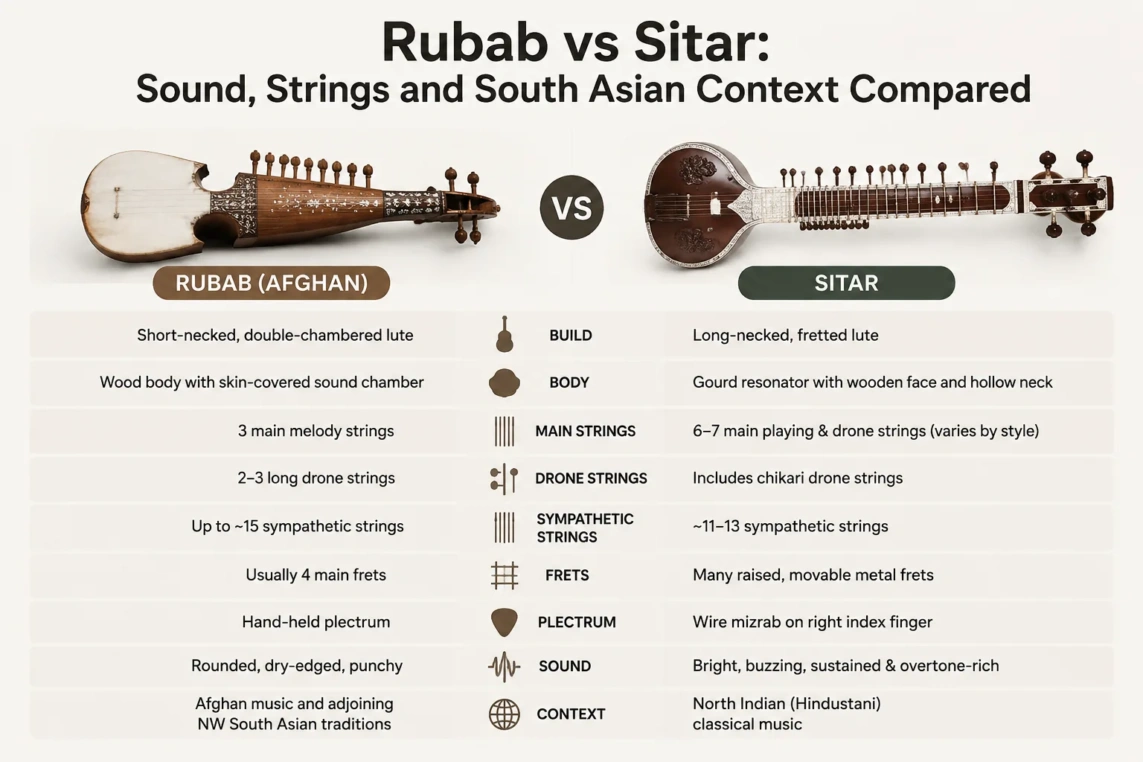
A rubab and a sitar can both surround a plucked melody with sympathetic resonance, but they produce that resonance through very different instruments. The Afghan rubab is compact, short-necked and partly skin-covered, with thick main strings and a firm plectrum attack. The sitar is long-necked, metal-strung and built around raised frets and a broad jawari bridge that gives its notes a brighter, buzzing sustain.
The distinction matters because “rubab” is not the name of one universal design. In this comparison, rubab means the Afghan or Kabuli rubab, the form strongly associated with Afghanistan and also present in parts of Pakistan and northern South Asia. It should not be treated as interchangeable with every rebab, rabab, rubob or regional lute carrying a related name.
Rubab and Sitar Are Built Around Different Acoustic Ideas
Both instruments belong to the broad family of plucked lutes, and modern forms of both can carry sympathetic strings. Their bodies, bridges, necks and primary strings are different enough that a listener can usually tell them apart within a few notes.
| Feature | Afghan Rubab | Sitar |
|---|---|---|
| Basic Form | Short-necked, double-chambered plucked lute | Long-necked, fretted plucked lute |
| Resonating Body | Usually carved from a solid block of wood, with skin covering the lower chamber | Large gourd resonator with a wooden face and hollow neck |
| Main Strings | Usually three melody strings | Common modern forms have six or seven upper playing and drone strings, depending on style |
| Drone Strings | Usually two or three long drones, with some setups adding other drone functions | Includes chikari drone strings among the upper strings |
| Sympathetic Strings | Common Afghan forms may have as many as about fifteen | Modern concert instruments commonly have roughly eleven to thirteen |
| Frets | A small number of frets; the standard Afghan form commonly uses four main frets | Numerous raised, movable metal frets |
| Plectrum | Hand-held plectrum | Wire mizrab worn on the right index finger |
| Typical Sound Character | Rounded, dry-edged, punchy and strongly articulated | Bright, buzzing, sustained and overtone-rich |
| Primary Cultural Association | Afghan music and adjoining traditions of northwest South Asia | North Indian Hindustani classical music |
Why the Rubab Has a More Percussive Attack
The lower resonating chamber of an Afghan rubab is covered with stretched skin rather than a wooden soundboard. The bridge stands on this membrane, so the energy of a plucked string reaches a surface that responds differently from the wooden top of a sitar.
The rubab body is traditionally hollowed from a block of wood, often mulberry. Its body is relatively compact, and its three main melody strings have historically been made from gut; nylon is common on modern instruments. These thicker strings do not behave like the thin metal melody strings of a sitar.
The result is an attack that can feel immediate and physical. A note has a clear center, and rapid alternate plectrum strokes remain sharply defined. The rubab can certainly resonate—the sympathetic strings make sure of that—but its resonance does not usually form the same long metallic cloud heard from a sitar.
This is why describing the rubab simply as a “deep sitar” is misleading. Its lower, fuller voice comes from a different body, different string materials and a different style of string-to-bridge interaction.
Why a Sitar Note Continues to Bloom After the Pluck
The sitar’s most recognizable acoustic feature is not merely the number of strings. It is the interaction between metal strings and the shaped bridge surface known as jawari.
The bridge is intentionally formed so that a vibrating string interacts with its broad curved surface. This creates the controlled buzzing edge associated with a properly adjusted sitar. The buzz is not an unwanted rattle. It is part of the instrument’s designed tone.
Behind that primary sound sits another layer. The sympathetic strings, usually called taraf or tarab strings, run beneath the main playing strings and respond when matching or closely related pitches are sounded. They add a delayed shimmer around the initial note.
A sitar therefore has several audible stages inside one pluck: the initial metallic attack, the jawari-rich vibration of the sounding string, and the softer response of sympathetic strings underneath it. That layered decay is one reason sustained sitar phrases can seem to continue after the player’s right hand has already moved on.
String Count Means Less Than String Function
Comparing the instruments by saying that one has “more strings” misses how those strings are organized. Neither instrument treats every string as an equal melody string.
How the Afghan Rubab Divides Its Strings
A standard Afghan rubab commonly starts with three main melody strings. These are the strings used for most of the fingered melodic work and are traditionally arranged around tuning relationships suited to the instrument’s repertoire. The three main strings are commonly tuned in fourths, although practical tuning depends on musical setting and player tradition.
Alongside them are usually two or three long drone strings. Their role is different from the main melody course: they reinforce tonal reference points and can become part of rhythmic plectrum patterns.
Below or beside these sounding courses sits a group of sympathetic strings. A full-sized Afghan rubab may carry up to about fifteen. These are tuned so that pitches important to the music respond when related notes are played on the main strings.
Not every rubab has exactly the same total. Size, regional construction and the maker’s setup can change the number of resonance and drone strings. A total-string figure without identifying the type of rubab is therefore of limited value.
How a Modern Sitar Divides Its Strings
A modern sitar commonly has six or seven strings running above the frets, but those strings do not all perform the same task. The setup can include a principal melody string, additional playing strings, bass strings on some styles, and high chikari strings used as rhythmic drones.
Beneath the raised frets sits a separate bank of sympathetic strings. Eleven to thirteen is common on modern instruments, although individual sitars differ. A documented modern concert sitar may therefore have around twenty strings in total.
The instrument’s setup also changes with playing tradition. Sitars associated with different lineages can place more emphasis on bass range, vocal-style melodic playing, or particular drone arrangements. A bare string count cannot show these differences.
Both Use Sympathetic Strings, but the Effect Is Not Identical
Sympathetic strings work through the same broad physical principle on both instruments: a string tuned to a suitable pitch begins vibrating even though the player has not directly plucked it. The sounding melody string transfers energy through the instrument and surrounding air, exciting a resonance string that is ready to respond at that frequency.
On the rubab, the response sits behind a strong plectrum attack and the characteristic skin-headed body. It adds depth and sustain without removing the instrument’s compact rhythmic character. Rubab players can also brush or strike parts of the resonance-string group for additional drone and rhythmic effects.
On the sitar, the sympathetic bank combines with metal melody strings and jawari. The result is generally a more conspicuous halo of upper partials. When the taraf strings are accurately tuned to the raga, important pitches can seem to open up more fully than neighboring tones.
For both instruments, sympathetic-string tuning is part of tone production, not an optional decorative detail. An instrument with many poorly tuned resonance strings can sound less alive than one with fewer strings adjusted carefully.
Frets Change How Each Instrument Shapes a Melody
The sitar’s tall, curved metal frets are among its defining physical features. They are tied onto the neck rather than permanently embedded like guitar frets, allowing their positions to be adjusted when needed.
More importantly, the frets leave room beneath the strings. A sitarist can pull a melody string sideways across a fret to produce meend, a controlled pitch bend that can travel across several notes. This is central to the vocal character of much sitar playing. A melodic phrase can move continuously between pitches instead of behaving like a sequence of fixed fretted notes.
The Afghan rubab uses a very different layout. Its short neck commonly carries four principal frets, while additional pitches can be reached farther along the fingerboard. The three-string melodic layout places a relatively wide collection of notes within a compact left-hand area.
Rubab phrasing therefore tends to rely more heavily on changes between strings, fret positions, ornamented attacks and intricate right-hand patterns. It can produce slides and inflections, but it is not constructed around the long lateral string pulls that define much modern sitar technique.
The Right Hand Reveals the Difference Just as Clearly
Both are plucked instruments, yet their plectra encourage different physical approaches.
The rubab is played with a hand-held plectrum. Alternating down and up strokes can be used rapidly, and right-hand articulation is a major part of Afghan rubab style. Repeated notes, rhythmic accents, drone strokes and brief strums can make the instrument sound almost partly percussive without turning it into a percussion instrument.
A sitarist normally wears a small wire plectrum called a mizrab on the index finger. Its metal-on-metal contact suits the sitar’s steel strings and supports characteristic patterns of inward and outward strokes.
The sitar’s right hand also interacts constantly with its drone strings. During faster passages, especially in jhala-like textures, melody strokes can alternate with ringing chikari notes. The listener hears a continuous tonal reference while the melody moves above it.
On the rubab, drones and resonance strings can also enter rhythmic patterns, but the texture remains tied to the instrument’s shorter, harder-edged attack.
Their South Asian Contexts Overlap Without Becoming the Same Tradition
The sitar belongs most clearly to the Hindustani classical tradition of North India. Its modern concert identity developed within North Indian musical practice, where it is used for raga performance and commonly paired with tabla. The sitar also became one of the most internationally recognized South Asian instruments during the twentieth century.
The Afghan rubab occupies a different cultural map. It is closely identified with Afghanistan, particularly Afghan and Pashtun musical traditions, while also having a long presence across adjoining areas of Pakistan and northern parts of the Indian subcontinent.
Afghan art music also absorbed and adapted musical ideas associated with North India. Raga concepts, sargam note names, tabla accompaniment and related compositional practices entered parts of the Kabul art-music tradition. The rubab could therefore operate inside music shaped by both Afghan practice and contact with Hindustani systems without becoming a sitar-like instrument.
This cross-border musical exchange helps explain why the two instruments can appear in related musical environments despite having different construction and performance identities.
The Rubab’s Closer Hindustani Relative Is the Sarod
When the comparison shifts from sound to instrument history, the sarod is a more direct point of reference for the Afghan rubab than the sitar is.
The Afghan rubab was known in parts of northern India, and instrument histories connect it with the development of the sarod. The later sarod retained several rubab-like features, including a skin-covered resonator and sympathetic strings, while developing a metal fingerboard, metal melody strings and a fretless playing surface suited to long slides.
The sitar followed another path. Its name is linked with the Persian setar, while its mature Indian form also reflects features of South Asian lute and vina traditions. Historical sitars were not identical to the modern concert instrument: nineteenth-century museum examples exist without sympathetic strings, showing that the present string arrangement emerged through continued development rather than appearing all at once.
Calling rubab and sitar “ancestors” of one another would therefore be inaccurate. They belong to intersecting histories of Persianate, Central Asian and South Asian musical exchange, but their direct lines of development are not the same.
“Rubab” Does Not Always Mean the Afghan Instrument
The spelling itself can cause confusion in comparisons. Rubab, rabab, rebab, robab and rubob have been used for several related and unrelated regional instruments across a very large geographic area.
The Afghan rubab described here is a short-necked plucked lute with a skin-covered lower resonator. A North Indian historical rabab, a Punjabi rabab associated with older Sikh musical traditions, a Pamiri rubab and other regional instruments should not automatically be assigned the Afghan instrument’s string count or construction.
This distinction has become even more relevant in heritage terminology. In 2024, UNESCO inscribed the Art of crafting and playing rubab/rabab on the Representative List of the Intangible Cultural Heritage of Humanity for Afghanistan, Iran, Tajikistan and Uzbekistan. That multinational recognition reflects a broader rubab/rabab cultural field rather than declaring every instrument carrying the name to be structurally identical.
What to Listen for in a Rubab and Sitar Sound Comparison
On a clean recording, first ignore pitch and listen to the beginning of each note. A rubab usually presents a compact, rounded pluck with a pronounced rhythmic edge. The membrane-covered body contributes to an attack that can feel close and immediate.
With the sitar, listen just after the pick touches the string. The tone develops into a brighter metallic buzz, then sympathetic strings add a finer layer beneath it. A single note may seem to expand after it has already been struck.
Next listen to melodic movement. A sitar phrase often exposes long meend bends across a raised fret, allowing one string to carry a fluid movement through several pitches. Rubab melody more often reveals the relationship between its three main strings, compact fretboard positions and sharply controlled plectrum patterns.
Finally, listen to the space between notes. The sitar tends to fill that space with jawari and lingering sympathetic resonance. The rubab leaves more of its rhythmic outline exposed, even when its own sympathetic strings are active. That difference in decay and articulation is often more useful for identifying the instruments than counting strings or comparing their overall size.