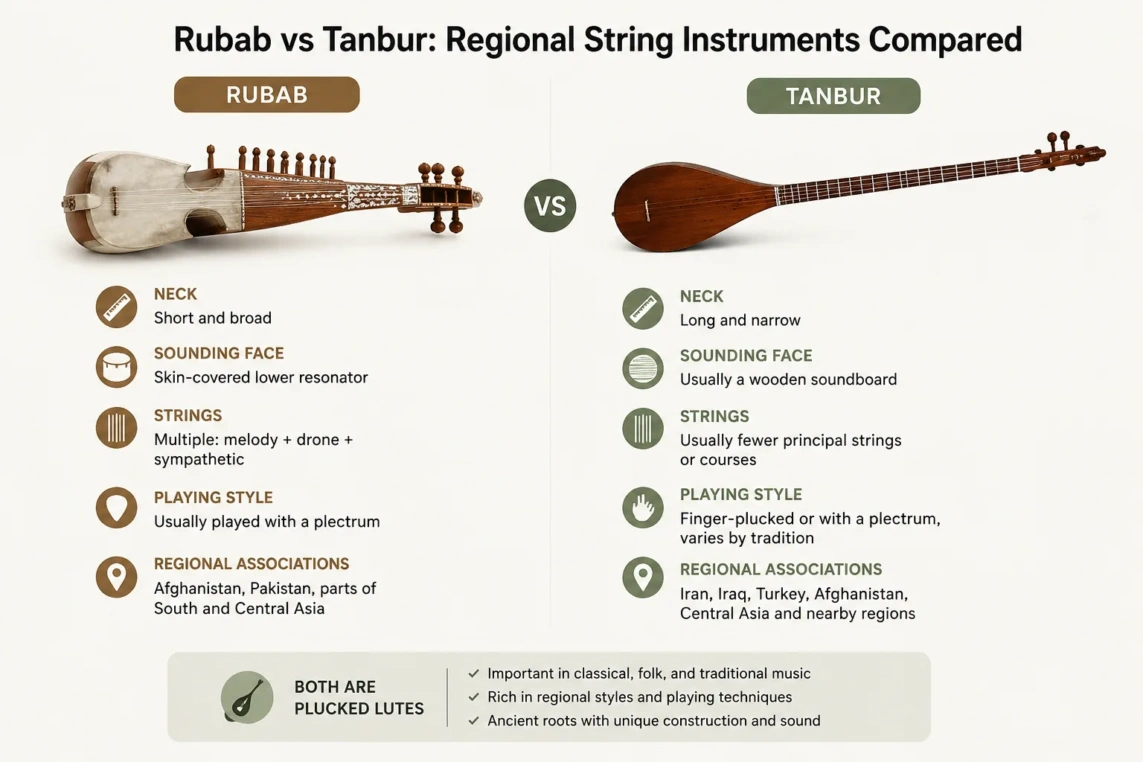
Rubab and tanbur are both plucked lutes, but they represent different construction ideas. The Afghan-style rubab is a short-necked instrument with a deep carved body, a skin-covered resonating face, and several groups of strings. Tanbur is a broader name applied to long-necked lutes across Iran, Iraq, Turkey, Afghanistan, and Central Asia, where the exact body shape, stringing, fret layout, and playing technique differ by tradition.
That difference in naming matters. Rubab, rabab, and rebab can refer to related but not identical instruments, and in some regions “rebab” names a bowed instrument rather than a plucked lute. Here, rubab means the Afghan and closely related plucked rubab tradition. Likewise, “tanbur” is treated as a family name rather than a single standardized model.
Rubab vs Tanbur: The Main Physical Difference
The easiest way to separate the two is to look at the neck and sound-producing surface. A rubab has a comparatively short neck and a skin-covered lower resonator. A tanbur normally has a much longer neck and a wooden soundboard.
| Feature | Rubab | Tanbur |
|---|---|---|
| Instrument type | Short-necked plucked lute | Long-necked plucked lute or family of related lutes |
| Body | Deep body commonly carved from a solid block of wood | Carved or built wooden bowl, depending on regional form |
| Sounding face | Skin membrane over the lower resonating area | Usually a thin wooden soundboard |
| Neck | Short, broad fingerboard area | Long and narrow |
| Strings | Main melody strings plus additional drone and sympathetic strings in many Afghan instruments | Usually organized as a smaller set of principal strings or courses; exact arrangement varies widely |
| Frets | A limited fretted playing area suited to the short neck | Frets extend along much more of the long neck |
| Right-hand technique | Normally struck with a plectrum | Finger-plucked or played with a plectrum, depending on tradition |
| Strong regional associations | Afghanistan, Pakistan, northern South Asia, parts of Central Asia | Iran, Iraq, Turkey, Afghanistan, Central Asia and neighboring traditions |
Why the Rubab Has a Short, Deep Body
The Afghan rubab is built around a compact, heavy-looking body rather than a long resonating neck. Museum examples are commonly carved from mulberry wood, with the body and hollowed areas shaped from a substantial piece of timber. The lower front is covered with animal skin, and the bridge rests on this membrane.
This construction separates the rubab from many wooden-faced lutes. When a string is plucked, the bridge transfers vibration into a stretched membrane rather than only into a wooden plate. The result is often described as a firm, immediate attack with a dry or percussive edge, followed by resonance from the body and, on many instruments, sympathetic strings.
The body also has a visibly divided profile. The lower resonating chamber is broad, while the upper body narrows before meeting the neck. This gives the rubab its recognizable waist-like outline. Decorative fingerboards, carved pegboxes, bone or mother-of-pearl inlay, and other ornament can be elaborate, but decoration varies from maker to maker.
Why the Tanbur Is Defined by Its Long Neck
Tanbur construction follows a different geometry. The neck is long in relation to the body, and the strings run over a wooden soundboard. This layout creates a broad fingered scale length and allows frets to occupy much more physical space than on a rubab.
The word tanbur does not identify one fixed silhouette. In western Iran, tanburs may have a pear-shaped wooden body and a long fretted neck. Historical and museum examples from Afghanistan can have bodies carved from mulberry with thin wooden tops and tied frets. The Ottoman Turkish tanbur developed another recognizable form, with a very long slender neck and a large rounded bowl.
These instruments belong to related long-necked lute traditions, but their dimensions, fret systems, string courses, and repertories should not be collapsed into one specification. A string count that is correct for one tanbur tradition may be wrong for another.
Strings and Resonance Work Differently
The Rubab Uses Several String Functions
A full Afghan rubab does more than carry a few melody strings across the fingerboard. Well-documented performance instruments combine three principal melody strings with additional drone strings and a bank of thin sympathetic strings. Historical and modern setups vary, but documented Afghan classical rubabs can carry roughly a dozen or more sympathetic strings.
The sympathetic strings are not normally plucked as the main melodic voice. They are tuned to pitches relevant to the mode or melodic material and vibrate in response to matching frequencies. This adds a layer of resonance beneath the stronger attack of the principal strings. Changing musical mode can therefore require retuning the sympathetic set.
Tanbur Stringing Depends on Which Tanbur Is Meant
Tanbur does not have one universal string arrangement. Some regional forms use only a few strings; others group strings into courses, and later modified instruments may add extra strings. The western Iranian tanbur tradition, the Central Asian tanbur, and the Ottoman Turkish tanbur should be treated separately when discussing exact tuning or string count.
For comparison with rubab, the useful distinction is functional: tanbur traditions generally focus their playing system on the long fretted neck and principal strings rather than on a large bank of sympathetic strings. The instrument’s identity comes mainly from its long-necked lute design, fret organization, and regional technique.
Fret Layout Changes How the Player Approaches Melody
Both instruments may be fretted, but the playing surface feels very different. The rubab concentrates its stopped notes on a short neck. The tanbur spreads its fret positions across a far longer neck, giving the left hand a different sense of distance and movement.
Many tanbur traditions use tied frets. These can reflect local pitch systems and repertory rather than the fixed equal-tempered fret spacing familiar from a modern guitar. The number and placement of frets vary by type and period.
Rubab fretting also needs regional context. The Afghan rubab uses a short fretted fingerboard for its main stopped strings, while the instrument’s additional strings have other functions. Its melodic technique therefore combines fretted note production with open-string resonance, drones, and sympathetic response.
The Right Hand Reveals Another Clear Difference
The Afghan rubab is normally played with a plectrum. The pick produces a defined attack that suits rhythmic articulation, repeated strokes, ornaments, and rapid melodic passages. Because the bridge sits on skin, the plucked note can feel more immediate than the note of a lightly finger-plucked wooden-faced lute.
Tanbur technique cannot be reduced to one method. Some tanbur traditions use finger techniques, while others use a plectrum. The Iranian tanbur is especially associated with developed right-hand finger patterns. The Turkish classical tanbur is normally played with a plectrum and has its own articulation system.
Two instruments carrying the tanbur name may therefore demand different right-hand habits. The shared long neck does not mean their technique is interchangeable.
Rubab and Tanbur Can Occupy the Same Broad Musical Region
Geographic overlap can make the pair look more closely related than their construction suggests. Rubab traditions are strongly associated with Afghanistan and extend into Pakistan, northern South Asia, and neighboring Central Asian settings. Tanbur-named lutes appear across a much wider belt through western and Central Asia.
They can even appear within the same regional music environment. Recordings from Badakhshan and other Central Asian contexts document rubab and tanbur as separate named instruments rather than two labels for the same lute. Geographic proximity does not erase their physical differences.
The Afghan Rubab Has a Distinct Relationship to the Sarod
One reason the rubab is often discussed beyond Afghanistan is its historical relationship with the North Indian sarod. Museum and music-history sources commonly connect the Afghan rabab or rubab with the development of the sarod. The later sarod has its own metal fingerboard, string system, repertory, and playing technique, so it should not be treated as simply another rubab.
Tanbur belongs to another network of long-necked lute forms. Names such as tanbur, tambur, dutar, setar, and related regional terms point to a long history of related terminology and instrument development across western and Central Asia. Similar names can suggest historical connections without meaning that all of the instruments share the same construction.
“Tanbur” Is a More Variable Name Than “Afghan Rubab”
A comparison becomes misleading if “tanbur” is presented as though it were a single museum model. The name has been used for several regional instruments across a large area. Three examples show the range:
- Western Iranian tanbur: a long-necked fretted lute closely tied to regional musical practice in western Iran and neighboring areas.
- Ottoman Turkish tanbur: a long-necked classical lute with a large rounded bowl and an extensive fret system.
- Central Asian tanbur: long-necked forms found in Uzbek, Tajik, and neighboring musical traditions, with their own dimensions, tunings, and repertories.
The rubab name also has variation, but “Afghan rubab” identifies a more specific construction tradition. Problems arise when the spelling variants rubab, rabab, and rebab are assumed to mean the same instrument everywhere. In Arab, Southeast Asian, and other contexts, closely related spellings may refer to bowed lutes with very different bodies and playing methods.
Sound Differences Begin with the Soundboard
Descriptions of tone are subjective, but the physical contrast between the instruments is clear enough to explain why they respond differently.
The rubab places its bridge on a skin membrane. This supports a quick attack and a focused, sometimes percussive character. Its sympathetic strings can then extend the apparent resonance after the initial pluck.
A tanbur normally transfers string energy through a wooden soundboard. The resulting response depends on body construction, string material, scale length, bridge design, and regional playing style. It is safer to describe tanbur tone by specific tradition than to assign one sound profile to every instrument carrying the name.
How to Identify a Rubab or Tanbur in a Photograph
Start with the neck-to-body ratio. If the instrument has a compact neck, a broad sculpted body, and a skin-covered lower face, it is likely a rubab or a closely related form. A row of many small side pegs can indicate sympathetic strings.
If the neck is dramatically longer than the body and carries many fret positions, the instrument is more likely to belong to a tanbur-type long-necked lute tradition. A fully wooden top is another useful clue.
- Short neck + skin face + sympathetic-string pegs: points toward Afghan rubab.
- Long neck + wooden face + extended fret system: points toward a tanbur-type lute.
- Long neck + very large rounded bowl: may indicate an Ottoman Turkish tanbur.
- Bow instead of plectrum: may indicate a bowed rebab or another instrument, not the Afghan plucked rubab discussed here.
Which Instrument Is Larger?
Overall length alone can be deceptive. A tanbur often appears longer because its neck extends far beyond the body. A rubab is shorter in neck length but has a deeper, heavier-looking resonating body. Individual examples vary enough that a single measurement should not be used as a universal identification rule.
The proportions are more useful than the absolute size: rubab emphasizes body depth and a compact neck; tanbur emphasizes neck length and a smaller or more streamlined resonator in relation to that neck.
Which One Is Closer to Other Familiar Lutes?
The rubab shares some visual and acoustic ideas with skin-faced plucked lutes and stands close to the historical line that leads toward the sarod. Its sympathetic strings also place it in conversation with several South and Central Asian instruments that use resonance strings.
The tanbur fits more naturally beside the broad family of long-necked fretted lutes found across western and Central Asia. Depending on the region, useful comparisons may include dutar, setar, saz, or other tanbur-derived and tanbur-related forms. These comparisons describe structural neighborhoods, not interchangeable instrument names.
Rubab and Tanbur Are Not Regional Names for the Same Instrument
The two can share geography, repertory spaces, and a general lute ancestry, but their defining construction is different. The rubab is centered on a short neck, carved body, skin-covered resonator, plectrum attack, and—in the Afghan classical form—multiple string functions including sympathetic resonance.
The tanbur is centered on the long-necked lute principle. Its wooden soundboard, extended fret layout, string arrangement, and right-hand technique change from one regional tradition to another. That regional variability is part of the instrument name itself and should be preserved whenever a tanbur is identified, described, tuned, or compared.