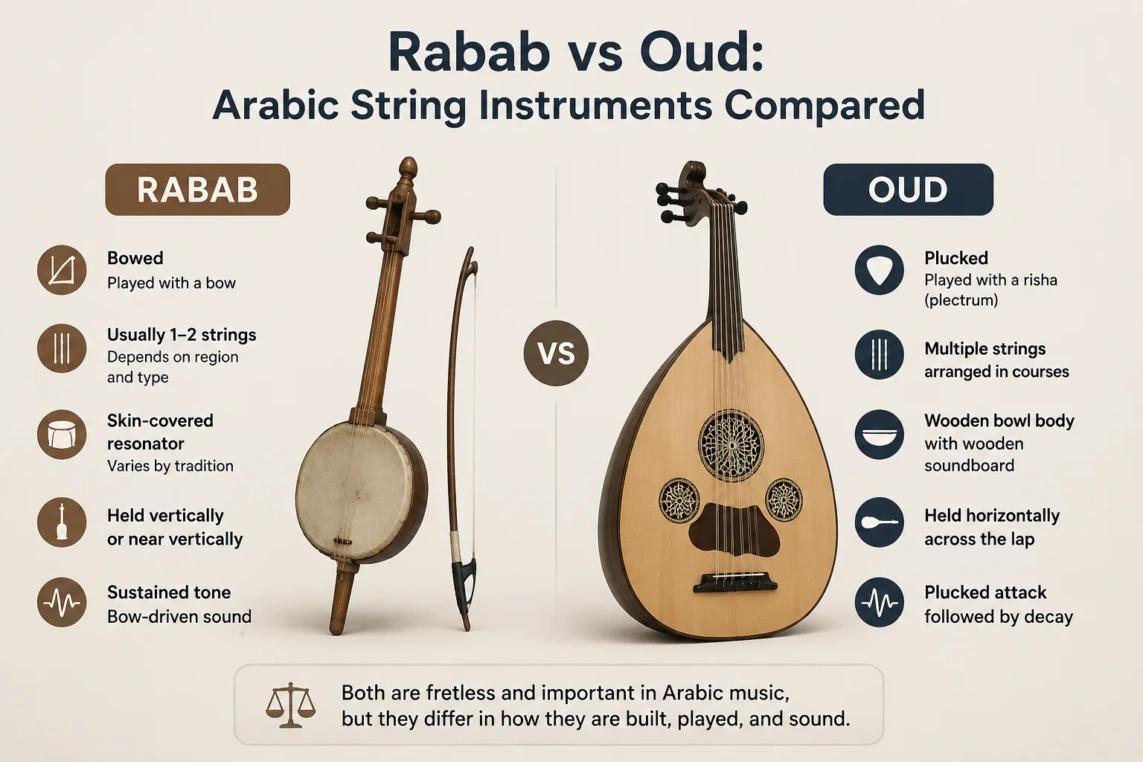
In Arabic musical contexts, the rabab and the oud belong to different branches of the string-instrument family. The Arabic rabab is usually a bowed, fretless fiddle, while the oud is a plucked, fretless short-necked lute. One produces sustained notes through a bow; the other uses a plectrum to create a clear attack followed by natural decay. Their construction, playing posture, technique, and customary musical roles are correspondingly different.
Naming note: “Rabab” can be confusing in English. Spellings such as rabab, rababa, rebab, rabāba, rubab, and robab are not always names for the same instrument. Here, rabab refers to the Arabic rabāba/rebab bowed tradition, not the plucked Afghan and Central Asian rubab.
Rabab and Oud Are Different Types of String Instrument
The easiest way to separate them is by looking at how the strings are set into motion. A rabab is played with a bow. An oud is normally played with a plectrum known in Arabic musical practice as a risha.
| Feature | Arabic Rabab | Oud |
|---|---|---|
| Instrument family | Bowed fiddle or spike-fiddle family | Short-necked plucked lute |
| How sound begins | Bow moves across the strings | Strings are plucked with a risha |
| Frets | Generally fretless | Fretless |
| Typical resonator | Skin-covered resonator in many Arabic forms | Wooden bowl-shaped body with a wooden soundboard |
| Strings | Often one or two in traditional Arabic forms, depending on region and type | Multiple strings arranged mainly in courses |
| Playing position | Usually held vertically or near vertically | Held horizontally across the lap |
| Right-hand tool | Bow | Risha or similar plectrum |
| Note character | Sustained bow-driven tone | Plucked attack followed by decay |
What the Arabic Rabab Actually Is
The term rabāba covers more than one regional form, so it should not be treated as the name of a single standardized model. Arabic examples commonly belong to the bowed lute or spike-fiddle group. Some have a simple frame or resonator covered with skin, a long neck, very few strings, and a spike or extension below the body.
An Egyptian rabāba preserved by the Metropolitan Museum of Art, for example, has two horsehair strings passing over a skin-covered coconut-shell resonator. Other Arabic instruments carrying the rabāba name can differ substantially. A quadrangular single-string form is also documented in Saudi Arabia.
This variation matters. Statements such as “the rabab has two strings” or “the rabab has a round body” are too absolute for the wider Arabic rabab family. String number, resonator shape, materials, and local terminology can change from one tradition to another.
The shared feature most useful for comparison with the oud is not a fixed body shape. It is the rabab’s identity as a bowed instrument in the Arabic forms discussed here.
How the Oud Is Built Differently
The oud belongs to the lute family. Its large body has a rounded, bowl-like back assembled from wooden ribs, while the front is a comparatively flat wooden soundboard. A short neck leads to a pegbox that commonly bends sharply backward from the neck.
The strings run from the bridge across a fretless fingerboard to the tuning pegs. Rather than using only one or two strings, an oud normally carries several strings organized into courses. A course consists of strings tuned and played together, although a lower course may use a single string in some modern setups.
The absence of fixed frets is one of the oud’s most recognizable technical features. The player places the fingers directly according to the required pitch rather than relying on metal or tied frets to divide the fingerboard.
The rabab may also be fretless, but its physical layout is very different. A player seeing a large wooden bowl, short neck, broad soundboard, several courses of strings, and no bow is looking at an oud rather than an Arabic rabab.
Skin Resonator vs Wooden Soundboard
One of the strongest visual differences lies in the resonating body.
Many Arabic rabab forms use animal skin stretched across a resonator or frame. The bridge transfers the strings’ vibration to this membrane. The exact body beneath it varies according to regional construction.
The oud uses a different acoustic arrangement. Its bridge is attached to a wooden soundboard, which works with the deep bowl-shaped back to project the vibrations of its plucked strings. Decorative sound holes or rosettes are also common features of many ouds.
These construction systems contribute to recognizably different responses. A bowed rabab can maintain a note as long as bow motion continues, while an oud string immediately begins losing energy after it is plucked. Material choice, dimensions, stringing, setup, and individual craftsmanship also shape the result, so neither instrument has only one fixed tone.
The Bow Changes the Rabab’s Musical Behavior
A bow gives the rabab access to something an oud cannot produce in the same physical way: continuous excitation of the string.
When the bow moves across a rabab string, friction repeatedly supplies energy. A player can therefore lengthen a tone, alter its intensity during the note, connect pitches smoothly, and shape short melodic phrases through changes in bow direction and pressure.
Traditional rabab technique can be deceptively economical. An instrument with one or two strings does not offer the same layout as a many-stringed lute, so melodic variety depends heavily on intonation, fingering, bow articulation, and rhythmic phrasing.
Depending on the rabab form, the left hand may stop or touch the string in a manner suited to that instrument rather than pressing it against a guitar-like fretted board. There is no single fingering method that should be imposed on every regional rababa.
The Risha Defines Oud Articulation
The oud player normally strikes the strings with a risha. Modern rishas are made in several materials and degrees of flexibility, but their function remains the same: they allow the right hand to articulate individual notes, repeated strokes, tremolo-like passages, chords, and rhythmic patterns across the courses.
Plucking produces a pronounced beginning to each note. This makes right-hand control especially important. Changes in attack, stroke direction, contact point, and force can alter the character of a phrase even before the left hand changes pitch.
Oud technique also makes regular use of movement between strings and courses. Melodies can cross several courses rather than remaining on a single string, while open strings may be incorporated into phrases according to tuning and melodic mode.
A rabab player manages continuity with the bow. An oud player manages repeated attacks with the risha. The right hand therefore organizes musical time differently on the two instruments.
Both Are Fretless, but Their Pitch Control Is Not Identical
The absence of frets links the two instruments technically, particularly in traditions where melodic intonation cannot be reduced to the fixed fret pattern of a modern guitar.
On an oud, the left-hand fingers stop the strings along a smooth fingerboard. This allows a trained player to place notes according to the melodic requirements of a maqam, including pitches and inflections that do not correspond neatly to equal-tempered guitar frets.
The Arabic rabab is likewise suited to flexible pitch placement, but its much smaller number of strings and bowed technique create another kind of physical relationship with the melody. Sliding between pitches, sustaining a tone, and adjusting intonation while bowing can become central parts of the performance language.
Calling both instruments “fretless” is therefore accurate but incomplete. The oud approaches fretless playing as a multi-course plucked lute; the rabab approaches it as a bowed fiddle.
Why They Do Not Sound Alike
The contrast in sound starts before wood species, body size, or string material is considered. It begins with bowing versus plucking.
Rabab Tone
A rabab can hold a tone continuously. The bow also allows changes in intensity within the life of a single note. Skin-covered resonators and sparse stringing give many traditional forms a direct and clearly defined response, although the exact timbre differs greatly between local instruments.
Because individual rababs may use different body designs and string materials, there is no responsible way to assign one universal sound description to every instrument carrying the name.
Oud Tone
An oud has the more obvious pluck-and-decay envelope of a lute. The initial strike is followed by resonance from the soundboard and bowl. Paired courses can add density to a single melodic line because two closely tuned strings may sound together during one stroke.
The oud can also use rapid repeated picking to create the impression of a more sustained line, but the mechanism remains repeated plucking rather than continuous bow contact.
Oud Has a Different Place in the Arabic Ensemble
The oud occupies a broad role in Arabic art-music practice. It appears as a solo instrument, vocal accompaniment instrument, and ensemble instrument and is strongly associated with the performance of maqam-based repertoire.
Its fretless neck and several courses make it well suited to melodic development. Players can move through wide melodic phrases, introduce ornamentation, support singing, and perform instrumental improvisation. The oud is also regularly heard alongside instruments such as the qanun, nay, violin, and percussion in Arabic ensemble settings.
The rabab has followed a different path. In several Arabic regions it is particularly associated with folk singing, oral poetry, regional performance, and smaller-scale accompaniment traditions. The instrument can support a singer without needing the dense string layout of an oud.
This division should not be made absolute. Rabab-type instruments have also appeared in older ensemble traditions, and regional musical cultures do not all divide instruments into the same social or musical categories.
The Egyptian Rabāba Shows How Its Role Changed
The history of the Egyptian rabāba gives a useful example of changing instrument roles. Museum documentation describes the rabāba as having once formed part of the Arabic ensemble, while the violin later took over much of that bowed-string role in formal ensemble settings.
The rabāba remained connected with folk singers and regional performance rather than simply disappearing. This helps explain why the modern listener may encounter the oud frequently in conservatory, concert, and art-music settings while encountering the rabab more often in traditional vocal or folk contexts.
That pattern describes a documented historical shift, not a rule for every Arab country.
Rabab, Rababa, Rebab, and Rubab Are Not Safe Synonyms
The naming problem is one of the main reasons these instruments are misidentified.
Rabab, rabāba, and rebab can represent different transliterations or regional forms of related names. Farther east, however, rubab or rabab can identify a plucked lute associated with Afghanistan and parts of Central and South Asia.
That instrument should not automatically be equated with the Arabic bowed rabāba.
- Arabic rabāba/rebab: often a bowed fiddle, with substantial regional variation.
- Afghan and related rubab: a plucked lute tradition with a different body, string system, and playing method.
- Oud: a separate fretless, short-necked plucked lute used widely across Arabic music and neighboring musical traditions.
Instrument classification should therefore rely on construction and playing technique, not spelling alone.
Rabab Is Not an Oud Played With a Bow
The two instruments are sometimes grouped too loosely because both are chordophones and both can be described under broad lute terminology in organological classification. That does not make them variations of the same instrument.
The Arabic rabab normally has a construction designed around bowed strings and vertical playing. The oud is designed around plucked courses, a broad wooden soundboard, and horizontal playing across the lap.
Their bridges, string arrangements, resonators, right-hand techniques, and performance habits developed around those different methods of producing sound.
An oud cannot simply become a rabab by adding a bow, and adding extra strings to a rabab would not turn it into an oud.
Which Instrument Is More Closely Related to the Lute?
The oud is the clearer answer when “lute” is being used in the familiar historical and visual sense of a plucked, necked string instrument. The oud itself is commonly described as an Arabian or Arabic lute and belongs to the historical family of short-necked lutes.
The word lute can also have a wider technical meaning in musical-instrument classification. Museums may classify bowed spike fiddles as forms of bowed lute because their strings extend along a neck and across a resonator.
This difference between everyday terminology and organological terminology explains descriptions that can otherwise look contradictory. Calling a rabāba a bowed lute does not mean it resembles an oud in playing technique.
Can Rabab and Oud Play the Same Maqam?
Both instruments can participate in music organized around maqam, but “playing the same maqam” does not mean they produce the same musical result.
The oud has several courses available for melodic movement, a fretless fingerboard, and a risha-driven articulation. A rabab may work with only one or two strings and relies on the bow to sustain and connect notes. Range, tuning, fingering, and customary melodic formulas also depend on the specific instrument and regional tradition.
A melody adapted from oud to rabab may therefore need different phrasing. Long bowed tones that feel natural on a rabab may require repeated strokes or tremolo on an oud. Fast course-crossing oud passages may need to be reshaped when transferred to a sparsely strung rabab.
Shared modal language does not erase instrumental technique.
Which Is Easier to Identify by Sight?
The oud has a very recognizable silhouette. Look for a large rounded bowl, short neck, bent-back pegbox, broad wooden face, and several courses of strings. It is played across the lap with a plectrum.
An Arabic rabab is more variable, but many forms can be recognized by a small skin-covered body, long neck, sparse stringing, vertical orientation, and bow. Some examples include a spike extending below the resonator.
If the body is skin-covered and the musician uses a bow, rabab/rabāba becomes a much more likely identification than oud. If the instrument has a large wooden bowl and is being plucked with a risha, it is likely an oud.
Playing Demands Are Different
Rabab Technique Centers on Bow and Intonation
A rabab player needs controlled bow contact, stable pitch placement, and the ability to create expressive melodic lines from a small number of strings. Producing an even note is itself a coordination task: bow speed, pressure, contact point, and left-hand intonation interact continuously.
Few strings do not necessarily mean few technical demands. Sparse stringing can make intonation and articulation more exposed because there are fewer mechanical features available to organize pitch.
Oud Technique Centers on Risha Control and Course Navigation
An oud player develops coordinated alternate strokes, string crossing, left-hand shifting, ornamentation, and control over several courses. Accurate intonation remains essential because the fingerboard has no fixed frets.
Different oud schools and performers also use different approaches to tuning, risha technique, posture, and ornamentation. There is no single playing setup shared by every Arabic oud tradition.
Rabab and Oud Can Belong to the Same Musical Culture Without Serving the Same Function
The presence of both instruments in Arabic and North African musical heritage is useful evidence against treating them as competing versions of one instrument. Moroccan Malhun, for example, has been documented with traditional accompaniment that includes both lute and rebab alongside other instruments.
In such a setting, each instrument contributes through its own mechanics. The lute supplies plucked articulation and resonance, while the rebab provides a bowed melodic voice capable of sustaining tones.
That relationship captures the practical difference between the two instruments particularly well. The rabab belongs to a bowed-string lineage; the oud belongs to a plucked-lute lineage. Their paths cross in Arabic musical culture, but their construction and playing language remain distinct.