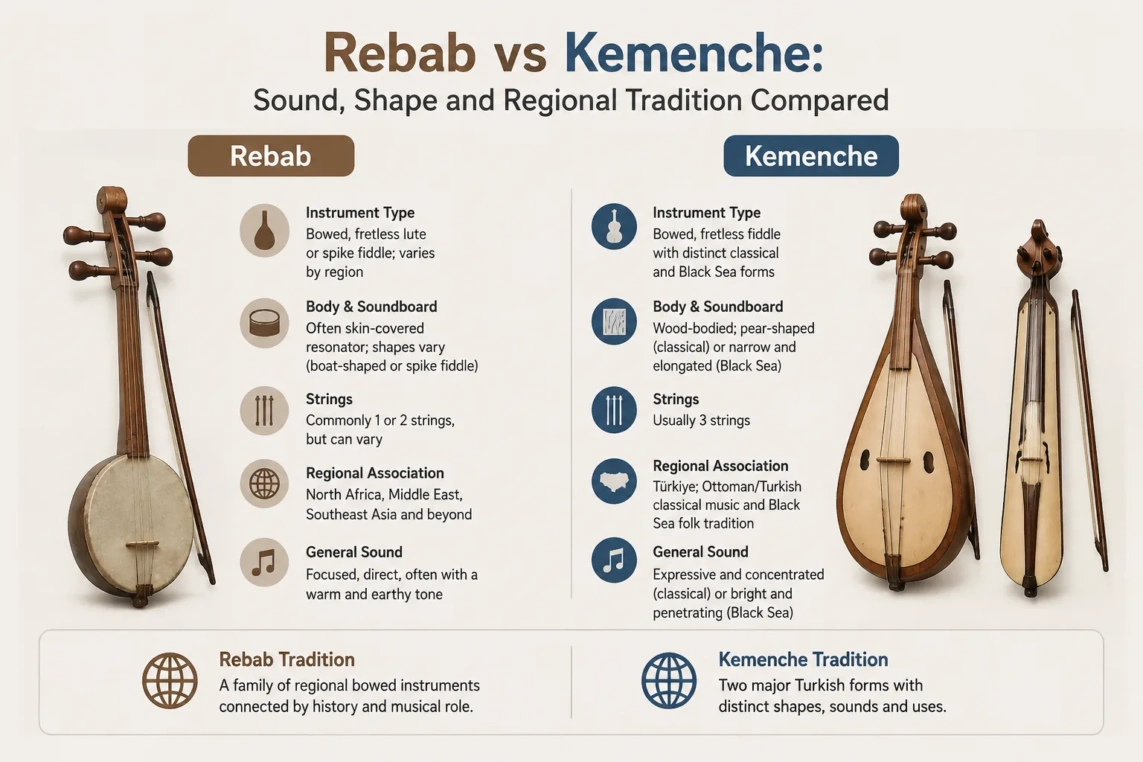
Rebab and kemenche are both bowed, fretless string instruments, but they should not be treated as two local names for the same fiddle. The rebab name covers several regional bowed-lute traditions extending from North Africa and the Middle East to Southeast Asia, while kemençe is especially associated with Turkish musical traditions and includes more than one distinct instrument type. Their bodies, resonating surfaces, playing techniques, tone and musical roles can therefore differ sharply.
This comparison uses rebab in its bowed sense. It does not refer to the Afghan rubab, which belongs to a different plucked-lute tradition despite the closely related spelling.
Rebab vs Kemenche: The Main Difference
The clearest distinction is physical. Many rebabs use a skin-covered resonator and may take the form of a spike fiddle or a short, boat-shaped bowed lute. Turkish kemenches are generally wood-bodied fiddles, but even here there are two forms that should be kept separate: the pear-shaped classical kemençe and the long, narrow Black Sea kemençe.
| Feature | Rebab | Kemenche |
|---|---|---|
| Instrument type | Bowed, fretless lute or spike fiddle; form varies by region | Bowed, fretless fiddle with distinct classical and Black Sea forms |
| Typical body | May be boat-shaped, narrow-bodied or built around a skin-covered resonator | Pear-shaped in classical kemençe; narrow and elongated in Black Sea kemençe |
| Soundboard | Skin or parchment is common in many documented forms | Primarily wooden construction in the major Turkish forms |
| Strings | Varies; one- and two-string forms are well documented, alongside other regional arrangements | Usually three strings in both traditional classical and Black Sea examples |
| General tone | Focused, direct and often distinctly colored by the skin resonator | Classical kemençe can sound concentrated and expressive; Black Sea kemençe is typically brighter and more penetrating |
| Regional association | North Africa, the Middle East and parts of Southeast Asia, among other regional traditions | Türkiye, especially Ottoman/Turkish classical music and the Eastern Black Sea folk tradition |
| Common musical role | Melody, vocal accompaniment or ornamental ensemble lines depending on the regional form | Classical ensemble melody or Black Sea folk song and dance accompaniment |
Why “Rebab” Does Not Describe One Fixed Shape
Rebab is a broad historical instrument name rather than a precise modern construction specification. Museum collections preserve instruments labeled rebab, rabāb or rabāba whose bodies, string arrangements and playing positions are not identical.
A North African rebab may be a short-necked, boat-shaped, two-string fiddle without frets. Other Arabic forms are spike fiddles with a skin-covered resonator. Examples from Java and neighboring musical cultures can also be long spike fiddles played vertically.
This variation matters when comparing the rebab with a kemenche. Saying that “the rebab has two strings” or “the rebab has a round body” would describe some examples accurately while excluding others.
Several recurring features are more useful than a single body outline:
- bowed strings rather than plucked performance in the forms discussed here;
- a fretless melodic function;
- frequent use of skin or parchment on the resonating body;
- regional construction traditions rather than one standardized model;
- close interaction with singing or an ensemble melody in many traditions.
The result is better understood as a family of regional bowed instruments connected by naming and musical history, not one instrument manufactured to a universal pattern.
Kemenche Has Two Major Turkish Forms
The word kemençe can create the same kind of confusion. In Türkiye, it is commonly used for two visibly different bowed instruments.
Classical Kemenche
The classical kemençe, also called armudî kemençe, has a compact pear-shaped body. It belongs to the sound world of Ottoman and Turkish classical music rather than the Black Sea dance tradition.
Traditional examples generally have three strings. The instrument is held upright, with its lower end supported near the player’s knee and the upper part positioned toward the chest. One of its most distinctive technical features is the way the player stops the strings: instead of pressing them down against a conventional fingerboard in violin fashion, the strings can be touched from the side with the fingernail.
This method gives the classical kemençe a very particular relationship between the left hand, string and bow. Fine pitch movement, slides and ornamental details can be controlled without frets.
Black Sea Kemenche
The Black Sea kemençe is a different instrument. Its body is longer, narrower and less pear-shaped. It is strongly associated with the Eastern Black Sea region of Türkiye and with regional folk repertories.
Traditional Black Sea instruments usually have three metal strings. The body is wooden, and the narrow soundbox allows the instrument to remain compact while producing the clear, cutting tone needed for its musical style.
The player holds the neck with the left hand and bows with the right. Unlike the side-of-the-nail technique strongly associated with classical kemençe playing, Black Sea technique commonly involves stopping the strings directly with the fingers. Players can also sound neighboring strings together, creating the closely spaced intervals and supporting tones heard in regional performance.
Calling both instruments simply “Turkish kemenche” without identifying the form hides an important difference. Classical kemençe and Black Sea kemençe belong to different repertories, playing techniques and instrument-making traditions.
Body Shape Changes the Way the Instruments Behave
The rebab–kemenche comparison becomes especially clear when looking at how the body is built.
Skin Resonators in Rebab Traditions
Many rebabs use stretched hide or parchment as part of the sound-producing body. The strings transmit vibration through the bridge into this membrane. The construction differs from the wooden soundboard familiar from many European bowed instruments.
Skin tension, bridge construction, resonator size and string material all affect the result. For that reason, two rebabs from different traditions may not sound alike even though both carry the same general instrument name.
Some North African rebabs have compact, boat-like wooden bodies partly covered with skin. Other rabāba-type instruments use a simpler resonating chamber with a membrane and a long neck or spike.
Wooden Bodies in Kemenche Traditions
Kemenche construction relies more heavily on a shaped wooden body and wooden soundboard. Wood choice can shape resonance, but body proportions, soundboard thickness, bridge design, strings and workmanship also matter.
The classical kemençe concentrates its resonating cavity into a short pear-shaped body. The Black Sea kemençe uses a much more elongated outline with a narrow waist and relatively shallow body.
These are not cosmetic differences. They influence how the bow interacts with the strings, how the instrument sits in the player’s hand or against the body, and how easily several strings can be reached during fast melodic movement.
How Their Sounds Differ
There is no single “rebab sound” because the instrument name covers several constructions. Still, skin-covered rebabs often have a direct, compact tone with a clearly defined attack. Depending on the instrument, the sound may seem dry, nasal, soft-edged or highly vocal in character.
A rebab used beside a singer does not need to imitate the tonal weight of a modern violin. Its timbre can instead remain clearly identifiable next to the voice, tracing melodic contours and adding small ornaments.
The two main kemenche types produce different impressions from each other as well.
Classical Kemenche Sound
The classical kemençe has a concentrated, expressive bowed tone suited to detailed melodic work. Its fretless strings and lateral fingering technique allow controlled slides and ornamentation that fit closely with Turkish classical melodic practice.
The instrument can move between sustained notes and finely articulated passages without needing a large resonating body. Its musical identity comes as much from bowing and fingering as from the wood itself.
Black Sea Kemenche Sound
The Black Sea kemençe normally gives a brighter, sharper and more penetrating sound. Steel strings contribute to that response, while regional bowing techniques can keep the music rhythmically active.
Neighboring strings may participate in the texture instead of every note being isolated as a single melodic pitch. This can create drones, parallel motion or closely linked supporting tones around the melody.
That sound is closely suited to the fast-moving repertory associated with Black Sea folk music and horon dance traditions.
The Bowed Playing Position Is Similar Only on the Surface
Seeing a rebab and a kemenche played upright can make them look more closely related than they are. The actual playing positions vary.
Some North African rebabs are supported across the player’s body, with the lower end near the knee and the upper part angled toward the shoulder. Many spike-fiddle rebabs from other regions are held more vertically, with the spike or lower end providing support.
The classical kemençe is also played upright rather than tucked beneath the chin like a violin. The instrument rests against the player’s lower body while its peg area is positioned higher toward the chest.
The Black Sea kemençe is compact enough to be controlled more freely with the left hand. Depending on the player and performance setting, it may be held in a more mobile position.
Vertical playing therefore does not make a rebab a kemenche. Body construction, fingering, string setup and repertory remain more useful identifiers.
Rebab Strings Vary More Than Kemenche Strings
String count is another area where broad statements can mislead.
Historical museum examples document one-string and two-string rebabs, including Arabic rebab and rabāba forms. Other regional rebabs use different arrangements. Horsehair and gut appear in older instrument traditions, while materials can vary with period and region.
The Turkish classical kemençe has traditionally been associated with three strings, although later experiments produced expanded versions. The standard Black Sea kemençe is also normally three-stringed and commonly uses steel strings.
This means that a three-string instrument is not automatically a kemenche, and a two-string bowed fiddle is not automatically a rebab. Shape, construction and regional context have to be considered together.
Regional Tradition Separates Them More Clearly Than Organology Alone
Rebab traditions cover a very wide geographic range. A rebab in a North African ensemble and a rebab in a Javanese gamelan share a historical instrument name, yet they participate in different musical systems.
In documented North African traditions, rebab forms have accompanied singing and taken part in Arabic ensemble practice. In Java, the rebab functions inside the gamelan ensemble, where its bowed line can decorate and interpret the melody rather than simply duplicate another instrument.
The kemenche has a more concentrated set of regional associations.
Classical kemençe belongs primarily to Ottoman and Turkish classical performance. It works alongside other instruments in a melodic ensemble tradition where ornament, intonation and modal detail carry much of the musical expression.
Black Sea kemençe belongs to a different social and musical setting. It is closely identified with communities of the Eastern Black Sea coast and neighboring areas, regional songs, gatherings and dances such as horon.
This difference in musical role is often more useful than trying to decide which instrument is “older” or which has the wider range. They developed within different performance needs.
Is the Kemenche a Type of Rebab?
Not in normal modern instrument classification. A kemenche should be identified as a kemenche rather than treated simply as another regional rebab.
There are historical relationships among bowed lutes across the Middle East, Anatolia, the Balkans, North Africa and neighboring regions, and instrument names have traveled between languages for centuries. Terms related to rebab, kamancheh, kemençe, lyra and rebec appear in discussions of this wider history.
That historical contact does not erase the distinctions that developed later. Modern instrument identity depends on construction and musical tradition as well as ancestry. The pear-shaped classical kemençe, Black Sea kemençe and various rebab forms are recognizable instruments in their own contexts.
Kemenche, Kamancheh and Rebab Should Not Be Merged by Name
The spelling can make comparison even harder. Kemenche is an English rendering of Turkish kemençe. Kamancheh usually refers to the Persian spike fiddle and related traditions. Rebab, rabab and rabāba form another shifting group of names.
Historically, musicians and writers did not always use these terms with the rigid boundaries expected from a modern catalog. A name could move into another language and become attached to a related but locally modified bowed instrument.
For present-day identification, the safest approach is to use the regional name together with the instrument type:
- North African rebab for the short bowed lute found in traditions of Morocco, Algeria and neighboring areas;
- Arabian or Arabic rabāba when referring to particular regional spike-fiddle forms;
- Javanese rebab for the bowed instrument used in gamelan traditions;
- classical kemençe or armudî kemençe for the pear-shaped Turkish classical instrument;
- Black Sea kemençe for the narrow three-string folk fiddle associated with the Black Sea region.
These labels preserve information that disappears when every bowed instrument with a related historical name is placed into one category.
Which Instrument Is Easier to Identify by Sight?
A classical kemençe can often be recognized by its compact pear-shaped outline and short neck. A Black Sea kemençe is noticeably narrower and longer, usually with an elongated wooden body and three strings.
A rebab requires more caution because its form changes by region. A visible skin membrane, fretless neck and bowed setup are useful clues, especially on spike-fiddle and North African forms, but they do not identify every instrument carrying the rebab name.
The most reliable identification combines body profile, soundboard material, string arrangement, playing position and place of musical use. No single visual feature works across every rebab tradition.
Two Bowed Traditions with Different Musical Priorities
The rebab often places the character of a skin-resonated bowed voice inside vocal, court, folk or ensemble traditions that vary widely across regions. Its identity changes considerably from North Africa to Southeast Asia.
The kemenche is more tightly connected to several Turkish and neighboring bowed-fiddle traditions. The classical instrument favors fine melodic control within Turkish classical music, while the Black Sea form combines a compact wooden construction, steel strings and energetic bowing with regional folk repertory.
What joins rebab and kemenche is therefore fairly simple: both belong to the long history of fretless bowed string instruments across connected musical regions. Their shapes, materials, techniques and local musical functions are distinct enough that each should still be understood on its own terms.