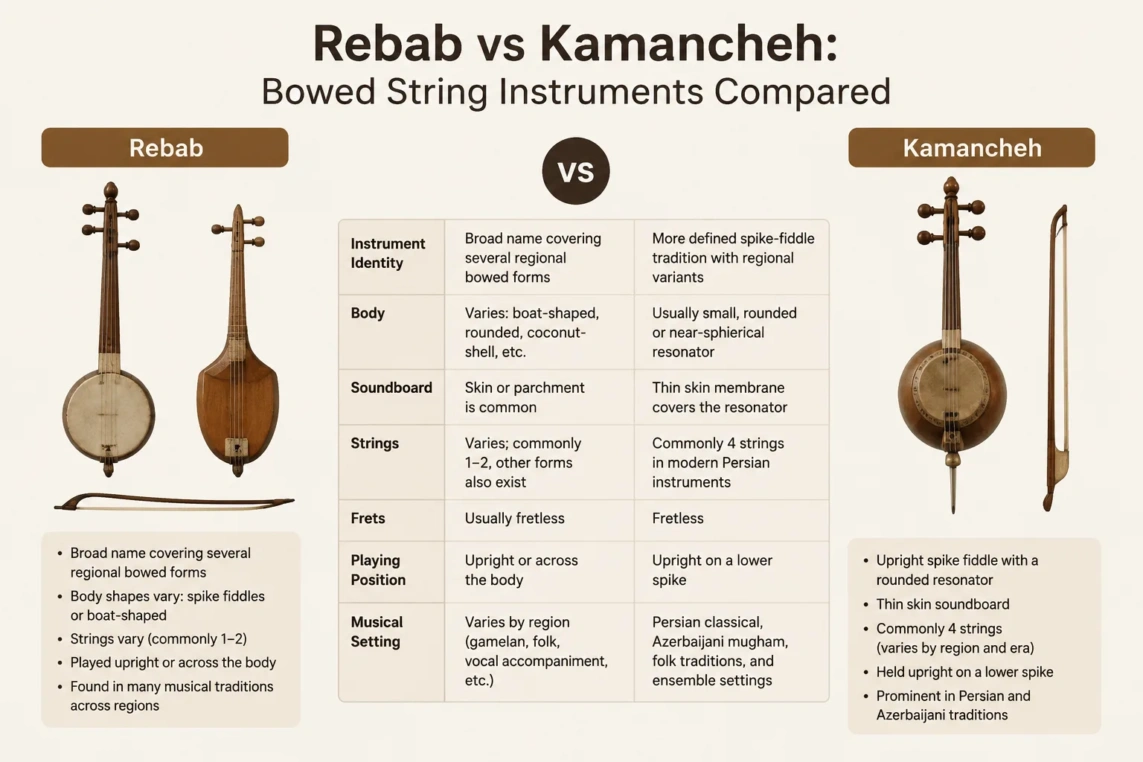
Rebab and kamancheh are both fretless bowed string instruments, but the names do not describe two fixed instruments of the same type. Kamancheh usually refers to a more clearly defined family of upright spike fiddles associated especially with Iranian and Azerbaijani musical traditions. Rebab, rabab, and related spellings have been applied to several bowed instruments across North Africa, the Middle East, and Southeast Asia, with major differences in body shape, playing position, strings, and musical role.
The closest visual comparison is between the upright spike-fiddle forms of the rebab and the kamancheh. A Javanese or Sundanese rebab, for example, shares the basic idea of a long fretless neck, membrane-covered resonator, bow, and upright playing position. A North African rebab can look and function quite differently.
Why Rebab and Kamancheh Are Not a One-to-One Comparison
The word kamancheh, also written kamancha or kamānča, is relatively specific in organological use. It commonly describes a spike fiddle with a small rounded resonating chamber, a skin soundboard, a long fretless neck, and a spike projecting below the body.
Rebab is a much broader name. Museum collections document rebabs ranging from upright spike fiddles with skin-covered resonators to boat-shaped fiddles held across the body. The same broad naming family also overlaps with rabab, rubab, rebap, rebob, and other regional spellings.
This matters because a statement such as “the rebab has two strings” or “the rebab is held vertically” can be correct for one regional form and wrong for another. The Afghan rubab, for instance, is primarily a plucked lute and should not be treated as the bowed rebab being compared here.
| Feature | Bowed Rebab | Kamancheh |
|---|---|---|
| Instrument identity | A broad name covering several regional bowed forms | A more defined spike-fiddle tradition with regional variants |
| Body | Can be boat-shaped, rounded, coconut-shell based, or otherwise regionally shaped | Usually has a small rounded or near-spherical resonating chamber |
| Soundboard | Skin or parchment is common in many bowed forms | A thin skin membrane covers the resonating chamber |
| Strings | Varies; one- and two-string forms are well documented, while other forms also occur | Modern Persian instruments commonly have four strings; regional and historical forms vary |
| Frets | Usually fretless in the bowed forms discussed here | Fretless |
| Playing position | Vertical in some traditions, across the body in others | Normally held upright on a lower spike |
| Musical setting | Depends strongly on region, including gamelan and vocal accompaniment | Persian classical, Azerbaijani mugham, regional folk traditions, and related ensemble settings |
Body Shape Makes the Fastest Visual Distinction
A typical Persian kamancheh has a compact rounded resonator at the bottom of a long neck. The resonating chamber is commonly made from wood, with mulberry and walnut documented in Persian instruments, and its open face is covered by a thin skin membrane. The bridge stands on this membrane.
A metal or wooden spike continues below the resonator. During performance, this lower support lets the instrument remain upright while still allowing the player to turn it slightly as the bow changes strings.
The rebab cannot be described with one body outline.
Javanese and Sundanese rebabs belong to the spike-fiddle side of the family. Museum examples show long, narrow instruments with skin-covered resonators and upright proportions that can make them look broadly related to the kamancheh.
North African rebabs can instead have a short-necked, boat-like body. Examples from Algeria and Morocco are commonly two-string fretless fiddles held diagonally or horizontally across the player’s body. Their silhouette is immediately different from the rounded Persian kamancheh.
Egyptian rabāba traditions introduce another variation: documented spike fiddles can use a coconut-shell resonator covered with skin. The result is structurally closer to the spike-fiddle idea but still belongs to its own regional instrument tradition.
The Kamancheh Is Consistently an Upright Spike Fiddle
The lower spike is not merely decorative. It affects the entire playing posture of the kamancheh.
The player sits with the instrument upright, supporting it below the resonator. The bow moves horizontally across the strings while the instrument itself can be turned to present different strings to the bow. Historical museum descriptions also document the traditional palm-up bowing position associated with this type of spike fiddle.
This relationship between bow movement and instrument rotation differs from the modern violin, where the instrument remains relatively fixed and the bow changes angle more visibly from string to string.
Some rebabs are played through a related upright technique. That is especially true of spike-fiddle forms. Other rebabs use a very different posture. A Maghrebi rebab may rest across the body, with the pegbox toward one shoulder and the lower part of the instrument near the opposite knee.
So playing position is a reliable clue only after the regional form of the rebab has been identified.
Strings and Setup Differ More Than Their Shared Bow Suggests
String count is another area where treating “rebab” as one instrument causes confusion.
The Indonesian rebab is widely documented as a two-string bowed lute. North African examples are also often two-string instruments. Historical Arab rabāba forms include instruments with one or two strings, depending on place and type.
The Persian classical kamancheh used today commonly carries four metal strings. Earlier kamancheh forms did not always use the same setup. Historical descriptions and surviving regional practices include instruments with different string numbers and materials, so the modern four-string arrangement should not be projected onto every period or community.
The kamancheh also has regional relatives and variants with three, four, or five strings. Construction therefore remains variable even within the more narrowly defined kamancheh family.
Both instruments are generally fretless in the bowed forms under comparison. Pitch is created directly by the player’s finger placement rather than by stopping the string against fixed frets. This supports fine pitch adjustment, slides, ornaments, and intonation patterns appropriate to each musical tradition.
Why Their Sound Can Be Similar but Still Easy to Separate
Both instruments can produce a sustained bowed line with rapid ornaments and continuous changes in pitch. Their skin-covered resonators also distinguish their response from bowed instruments built around a wooden soundboard such as the European violin.
Beyond that shared character, there is no single “rebab sound.”
A Javanese rebab operates within the sound field of the gamelan. Its bowed tone can move between and around the ensemble’s more percussive attacks, allowing the player to shape melodic contours and ornaments that cannot be sustained in the same way by struck metallophones.
A North African rebab has a different construction, string setup, posture, and repertory. Its sound therefore should not be used as a substitute for the sound of an Indonesian rebab simply because both instruments share the same name.
The kamancheh produces a sustained, highly flexible melodic line suited to detailed ornamentation and gradual pitch movement. Its small membrane-covered chamber and bowed metal strings give it a direct response, while bow pressure, contact point, fingering, and the individual instrument strongly affect the final tone.
Wood species alone does not determine this sound. Resonator dimensions, membrane thickness and tension, bridge setup, strings, bowing technique, and the player’s touch all interact with the body material.
Rebab in Gamelan and Kamancheh in Persian Music Serve Different Jobs
The contrast becomes clearer when the instruments are placed back into their musical systems.
The Rebab in Javanese and Sundanese Ensembles
In Indonesian gamelan traditions, the rebab is a melodic bowed instrument among predominantly struck instruments. Rather than simply doubling every note played by the metallophones, it can elaborate the melodic course with flowing movement and ornamentation.
This is an important distinction. The rebab’s value in the ensemble comes partly from what bowing makes possible: notes can be sustained, connected, inflected, and shaped differently from the sounds produced by gongs and metallophones.
The exact repertory and function differ among Javanese, Sundanese, and Balinese settings. “Indonesian rebab” is therefore still broader than the name of one standardized instrument.
The Kamancheh in Persian Classical Music
In Persian classical performance, the kamancheh works as a fully developed melodic voice. It can present repertory, accompany singing, exchange phrases with a vocalist, and interact with instruments such as the tar, setar, santur, ney, and tombak according to the ensemble and performance setting.
Its ability to sustain notes creates a useful contrast with plucked Persian lutes. A bowed phrase can continue through a tone where the sound of a plucked string naturally begins to decay.
Kamancha in Azerbaijani Mugham
The closely related kamancha also holds an established place in Azerbaijani music. A well-known mugham ensemble format combines kamancha with tar and a singer who may also play a frame drum.
The craftsmanship and playing traditions of Kamantcheh/Kamancha in Iran and Azerbaijan were inscribed on UNESCO’s Representative List of the Intangible Cultural Heritage of Humanity in 2017. The recognition concerns the living skills of making and playing the instrument rather than declaring one fixed design for every practitioner.
Rebab Has a Wider Geographic Naming Range
The geographic reach of the rebab name is much wider than a single instrument map might suggest. Related names appear across North Africa, Arabic-speaking regions, parts of West and Central Asia, and Southeast Asia.
That spread created a naming problem for modern readers: instruments separated by large distances can share a form of the word rebab while differing markedly in construction.
- Algeria and Morocco: boat-shaped bowed rebabs are documented in traditional vocal and ensemble settings.
- Egypt: rabāba can describe folk spike fiddles, including forms using skin-covered coconut resonators.
- Arabian regions: several bowed rabab traditions have existed with different body forms and string arrangements.
- Java and Sunda: rebab identifies a long-necked bowed instrument used within gamelan traditions.
- Other parts of Southeast Asia: related rebab names and local instrument forms occur in several musical traditions.
Kamancheh terminology also crosses linguistic and political boundaries, but its organological meaning remains more tightly connected to the upright spike fiddle.
Are Rebab and Kamancheh Historically the Same Instrument?
They are related within the wider history of bowed lutes and spike fiddles, but treating one as simply another name for the other hides too much historical variation.
The Persian term kamānča is documented in medieval sources, and related instruments appear repeatedly in later Persian musical writing and visual art. Historical evidence also shows forms of the word rabāb being used during overlapping periods.
More importantly, those names did not always identify the same type of chordophone. Medieval Persian writing could distinguish a kamānča as a bowed instrument from a rabāb that was plucked. In later regions and periods, rabab or rebab became firmly associated with bowed instruments.
The evidence therefore does not support a simple naming equation in which every historical rebab became a kamancheh, or every kamancheh was merely a rebab under another name.
They are better understood as instruments formed within overlapping networks of bowed-string construction, terminology, movement, and regional adaptation.
Kamancheh, Kemenche, and Rebab Should Not Be Merged
The similarity between kamancheh and kemenche creates another source of confusion.
The names are historically related, but modern instruments carrying them may be physically different. The Persian kamancheh is normally an upright spike fiddle with a rounded membrane-covered resonator. Turkish instruments called kemençe include short-necked bowed forms with their own body shapes, playing positions, tunings, and regional traditions.
Likewise, the spelling rubab often points modern readers toward the Afghan and related plucked lutes rather than toward a bowed rebab.
For instrument identification, construction and playing method are safer than spelling alone.
How to Tell a Rebab from a Kamancheh by Sight
If an unidentified bowed instrument has a small rounded body, skin face, long fretless neck, four tuning pegs, and a prominent lower spike, a Persian-style kamancheh is a strong possibility.
If it has two strings and an elongated upright form in an Indonesian musical setting, it may instead be a Javanese or Sundanese rebab.
If the instrument has a boat-shaped body and is held across the player’s torso, a North African rebab is more likely than a kamancheh.
A coconut-shell resonator does not settle the question by itself. Coconut-bodied spike fiddles occur in regional rabāba and related traditions, while other spike fiddles use carved wooden resonators.
Context helps as much as shape. A rebab among gamelan instruments and a kamancheh beside tar and Persian percussion may both be bowed and fretless, yet they belong to different systems of construction, repertory, technique, and musical thought.
Rebab or Kamancheh: Which Name Is More Precise?
Kamancheh is usually the more precise instrument name. It points toward a recognizable spike-fiddle tradition even though individual instruments and regional versions still vary.
Rebab requires a regional qualifier whenever accuracy matters. “Javanese rebab,” “Sundanese rebab,” “North African rebab,” or “Egyptian rabāba” communicates far more than rebab by itself.
That naming difference is also the main distinction between the two. The kamancheh can be compared directly as an instrument family. Rebab is better treated as a regional naming family containing several bowed forms. Some of those forms come close to the kamancheh in construction; others differ in almost every visible detail except the use of a bow and fretless strings.