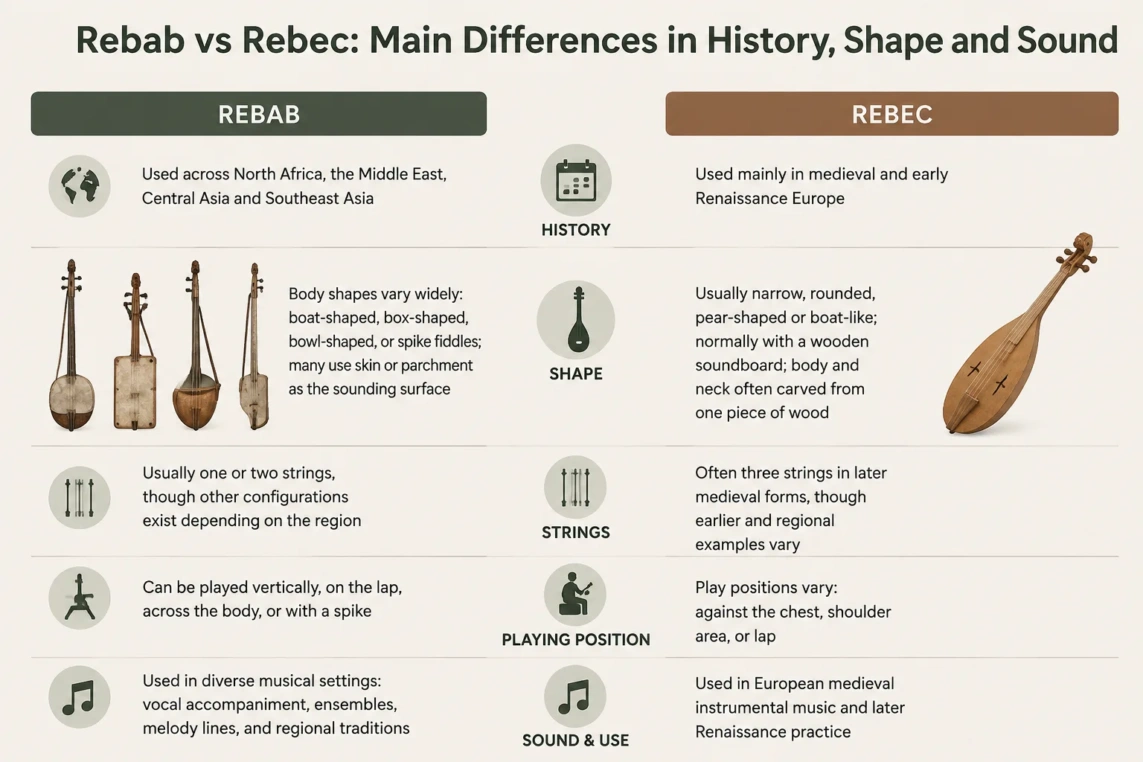
The rebab and rebec are related bowed string instruments, but they are not interchangeable names for the same instrument. Rebab is a broad name applied to several bowed instrument traditions across North Africa, the Middle East, Central Asia, and Southeast Asia. The rebec belongs more specifically to medieval and early Renaissance Europe, where it developed its own recognizable construction and musical identity.
The historical connection between them is real. Forms of the rabāb reached medieval Europe through Mediterranean cultural contact, and the name is closely connected with later European terms such as rebec. Yet the European rebec should not simply be described as a rebab with a different spelling. Its wooden body, string arrangement, playing traditions, and later development distinguish it from many instruments called rebab.
Rebab vs Rebec: The Main Difference
| Feature | Rebab | Rebec |
|---|---|---|
| Instrument identity | A broad family name covering several regional bowed string instruments | A more narrowly defined European medieval bowed instrument |
| Historical setting | Associated with musical traditions across Islamic-influenced regions and later parts of Asia | Associated mainly with medieval and early Renaissance Europe |
| Typical body | Varies greatly; may be boat-shaped, box-shaped, bowl-shaped, or built as a spike fiddle | Usually narrow, rounded, pear-shaped, or boat-like |
| Sounding surface | Many forms use skin or parchment over the resonator | Normally associated with a wooden soundboard |
| Strings | Depends strongly on the regional form; one- and two-string examples are well documented, alongside other configurations | Often three strings in later medieval forms, although earlier and regional examples vary |
| Neck and body construction | No single construction pattern applies to all rebabs | Body and neck were commonly carved from one block of wood |
| Playing position | May be held vertically, against the lap, across the body, or supported by a spike | Historical images show several positions, including against the chest, shoulder area, or lap |
| Musical setting | Varies from vocal accompaniment to ensemble melody and regional performance traditions | Used in European medieval instrumental music and later Renaissance practice |
The Historical Relationship Between Rebab and Rebec
The similarity between the words rebab and rebec is not accidental. Medieval European terminology for the rebec is connected with Arabic names including rabāb. Museum records for North African rabābs also note their connection with the emergence of the European rebec around the later medieval period.
This relationship is best understood as transmission followed by adaptation. Instruments, names, construction ideas, and playing practices moved through the Mediterranean, particularly through regions where Arabic, Iberian, North African, and European musical cultures were in contact. Once established in Europe, the rebec developed within European instrument-making practice rather than remaining structurally identical to its predecessors.
The surviving evidence requires some restraint. Very few complete European bowed instruments survive from the earlier Middle Ages, so much of what is known about the rebec comes from paintings, sculpture, manuscript imagery, written descriptions, inventories, and later surviving instruments. Medieval terminology was also inconsistent. A name used for one bowed instrument in one source could overlap with another term elsewhere.
It is therefore safer to describe the rebec as historically related to and influenced by the rabab/rebab tradition rather than claiming that one fixed rebab design simply became the rebec without intermediate changes.
Why “Rebab” Does Not Describe One Body Shape
One of the easiest mistakes in a rebab vs rebec comparison is to draw a single rebab silhouette and treat it as universal. Rebab is an instrument name with unusually broad regional use.
North African examples may have a short neck and a narrow boat-shaped resonator covered partly with skin. Some Arabian and Syrian instruments use a very different construction, including rectangular or framed bodies with stretched hide. Egyptian rabāba forms can use a skin-covered resonator and a long spike. Indonesian rebabs are generally vertical spike fiddles and belong to another regional construction tradition.
These instruments share historical and terminological connections, but their bodies are not identical.
Useful distinction: the word rebec usually points toward a recognizable European medieval instrument type. The word rebab must normally be interpreted together with a region, tradition, or specific instrument form.
The Rebec Has a More Recognizable Wooden Profile
The classic rebec is usually described as a small bowed instrument with a narrow pear-shaped or boat-shaped body. Its neck flows directly into the resonator, and historical examples and reconstructions often show the body and neck hollowed from a single block of wood.
A separate wooden top closes the resonating cavity. This creates a construction very different from the membrane-covered sound chambers found on many rebab types.
The rebec normally has:
- a compact rounded or pear-like body;
- a relatively short neck;
- no prominent violin-style body corners;
- a fretless fingerboard in commonly documented forms;
- a wooden resonating structure;
- lateral tuning pegs near the upper end;
- strings running across a bridge and bowed above the body.
Its outline can appear surprisingly simple beside a later violin. There is usually no sharply defined waist separating upper and lower bouts. The body instead forms a continuous curved shell.
Skin-Faced Rebab and Wooden Rebec Bodies Behave Differently
The difference between membrane and wooden soundboards is one of the most useful physical distinctions between many rebabs and the rebec.
On a skin-faced rebab, string vibration passes through the bridge into a stretched membrane. The membrane is thin and light compared with a carved wooden soundboard. Its tension, thickness, humidity, bridge design, body volume, strings, and bowing technique can all affect the instrument’s response.
The rebec instead transfers vibration through a bridge into a wooden top and hollow wooden body. Its narrow resonator and relatively small dimensions give it a different response from a large later bowed instrument.
This does not mean that every rebab has one recognizable “rebab sound.” A two-string North African rebab, a Syrian poet’s fiddle, and a Javanese rebab should not be expected to sound identical merely because their names are related.
How Their Sound Actually Differs
A rebec is commonly associated with a compact, direct bowed tone, particularly in smaller reconstructions. Its limited body volume and relatively short strings can favor a clear upper register. Modern descriptions sometimes call the rebec nasal or penetrating, but such labels should be treated carefully: playable original medieval rebecs are extremely rare, and modern reconstructions differ in dimensions, strings, bridges, bows, and setup.
Many membrane-faced rebabs produce a noticeably different kind of response. The skin surface can give the beginning of a bowed note a focused, immediate character, while the resonator and string material shape how much warmth, sustain, and upper-frequency detail follows.
Sound also depends on the specific rebab being compared. A one-string rebab used with sung poetry cannot be treated acoustically as though it were the same instrument as a two-string North African rebab or the bowed rebab used in a Javanese or Sundanese ensemble.
For that reason, the most accurate comparison is structural:
- Rebec: usually a compact wooden resonator supporting bowed strings.
- Many rebabs: a lighter membrane-covered resonator coupled to bowed strings.
Those two acoustic systems respond differently even before tuning and playing style are considered.
String Counts Are Not a Reliable Identification Method by Themselves
The rebec is often presented as a three-string medieval fiddle. Three strings were indeed common, particularly in later medieval and Renaissance forms, and historical scholarship also discusses tuning in fifths. Earlier depictions and written evidence, however, include other string counts.
Rebab string counts are even less suitable for a universal definition.
Documented instruments include:
- one-string poet’s fiddles;
- two-string North African and Middle Eastern rebabs;
- two-string Southeast Asian spike fiddles;
- regional forms with additional strings or more elaborate arrangements.
A statement such as “rebabs have two strings while rebecs have three” is therefore useful only as a rough comparison between certain forms. It is not a dependable family-wide rule.
The Bowing Position Can Reveal the Tradition
Both instruments are bowed, but how the instrument is held can differ considerably.
Many spike-fiddle rebabs are played vertically. The lower part of the instrument may rest on the player’s lap, a supporting surface, or a spike, leaving the resonator upright while the bow travels horizontally across the strings.
North African short-necked rebabs can use another posture. Museum descriptions record examples held across the player’s body, with one end near the shoulder and the other supported toward the knee.
The European rebec also lacked one universal playing posture. Medieval visual sources show bowed instruments held in different ways, and the rounded end of early rebec-like instruments could be supported against the body or lap. Later European bowed-instrument technique should not automatically be projected backward onto every medieval rebec.
The Rebec Became Part of a European Bowed-Instrument Lineage
Once established in Europe, the rebec occupied a musical environment that also contained fiddles, vielles, later viols, and other bowed instruments. Its history therefore belongs partly to the development of European bowed-string construction.
The rebec is frequently described as an ancestor or relative of later violin-family instruments. That description needs one qualification: the violin did not emerge from a single straight evolutionary chain in which the rebec simply changed shape until it became a violin.
European instrument makers were working with several bowed traditions. The rebec contributed to that broader history alongside instruments such as the vielle and later Renaissance bowed forms.
Its compact carved body remained visually distinct from the assembled ribs, separate plates, pronounced waist, and cornered outline that became characteristic of the violin family.
Rebab Traditions Continued Along Their Own Paths
The rebab did not disappear when related instruments appeared in Europe. Regional rebab traditions continued developing independently, which is why the name today covers instruments that may look very different from a medieval European rebec.
North African Rebab
Traditional rebabs from Morocco, Algeria, and neighboring areas can have a short neck, a narrow body, two strings, and a hide-covered resonating area. These instruments have been used within Arabic musical ensembles and in support of vocal music.
Arabian and Levantine Rababa Forms
Other forms use a simpler skin-covered resonator, a long neck or spike structure, and one or two strings. Some are closely associated with vocal narration and sung poetry. Their construction can be far removed from the carved wooden shell of a European rebec.
Southeast Asian Rebab
In Indonesia, the rebab became established as a bowed spike fiddle with its own playing technique and ensemble role. In gamelan traditions, the rebab can ornament and interpret melodic material rather than functioning like a European medieval fiddle.
These examples explain why comparisons based only on the English words rebab and rebec can be misleading. One side of the comparison represents several living regional instrument traditions; the other refers mainly to a historical European type.
Rebab and Rebec Names Tell Part of the History
The spellings rebab, rabab, rabāb, and rababa reflect different transliterations and regional usages. They do not always identify one precisely standardized instrument.
Rebec, together with historical spellings and related European names, belongs to the later European branch of this terminology. Forms such as rabel and rabeca appear in parts of the Iberian and European instrument vocabulary, although each term has its own regional history.
The similarity of the names preserves evidence of contact, but name ancestry and instrument identity are not the same thing. Two instruments can share an etymological connection while differing substantially in construction and performance.
How to Tell a Rebab From a Rebec in a Museum or Illustration
Identification is easiest when several physical clues are considered together rather than relying on string count alone.
Look for a Skin Membrane
If much of the resonator face is covered with visible skin or parchment, a rebab-family identification becomes more likely than a typical European rebec identification.
Check Whether the Body Is a Narrow Carved Wooden Shell
A small instrument whose rounded body and neck appear to form one continuous carved wooden unit strongly matches the common rebec construction pattern.
Look for a Spike
A long rod extending through or beneath the resonator points toward a spike-fiddle form of the rebab or another related spike fiddle rather than the usual medieval European rebec.
Do Not Use Three Strings as Proof
Three strings fit many rebec reconstructions and historical descriptions, but string count alone cannot settle an identification. Both historical bowed instruments and regional rebabs vary.
Use Geographic and Date Information
A bowed instrument identified with medieval France, England, Iberia, Italy, or another European setting may reasonably be examined as a possible rebec or related medieval fiddle. A similarly named instrument from Algeria, Morocco, Syria, the Arabian Peninsula, Egypt, Java, or Sunda may belong to a very different rebab tradition.
Why Historical Rebec Reconstructions Do Not All Look the Same
Modern rebecs are often reconstructions rather than direct copies of a large surviving collection of medieval originals. Makers work from iconography, written evidence, surviving later instruments, sculpture, and comparative organology.
This creates legitimate differences between reconstructed rebecs. One maker may produce a two-string instrument based on an early image, while another builds a three-string form associated with later medieval evidence. Body proportions, bridge curvature, pegbox shape, string material, bow design, and playing position can also differ.
The same caution applies when comparing a reconstruction directly with a museum rebab made centuries later. The museum instrument may document a continuing regional tradition, while the rebec reconstruction is an interpretation of incomplete medieval evidence.
Which Instrument Is Older?
The rabāb/rebab tradition precedes the European rebec as a named and historical lineage. Medieval European rebec terminology developed after bowed rabab-type instruments were already present in Islamic and Mediterranean musical cultures.
That does not provide an exact birth date for either instrument. Bowed-string history is complicated by changing terminology and limited surviving material. What can be stated more securely is that the rebec belongs to a later European development connected with earlier rabab traditions rather than representing an unrelated invention with a coincidentally similar name.
Why the Rebab–Rebec Connection Matters
The rebab and rebec show how a musical instrument can cross regions without remaining physically unchanged. The name travelled, construction ideas travelled, and bowing traditions travelled, but instrument makers adapted what they received to local materials, musical needs, and existing craft practices.
That is why a medieval European rebec can be historically connected with the rabāb while looking unlike an Egyptian spike fiddle or Indonesian rebab. Their relationship is best understood as a branching instrument history: related terminology and earlier ancestry followed by distinct regional development.