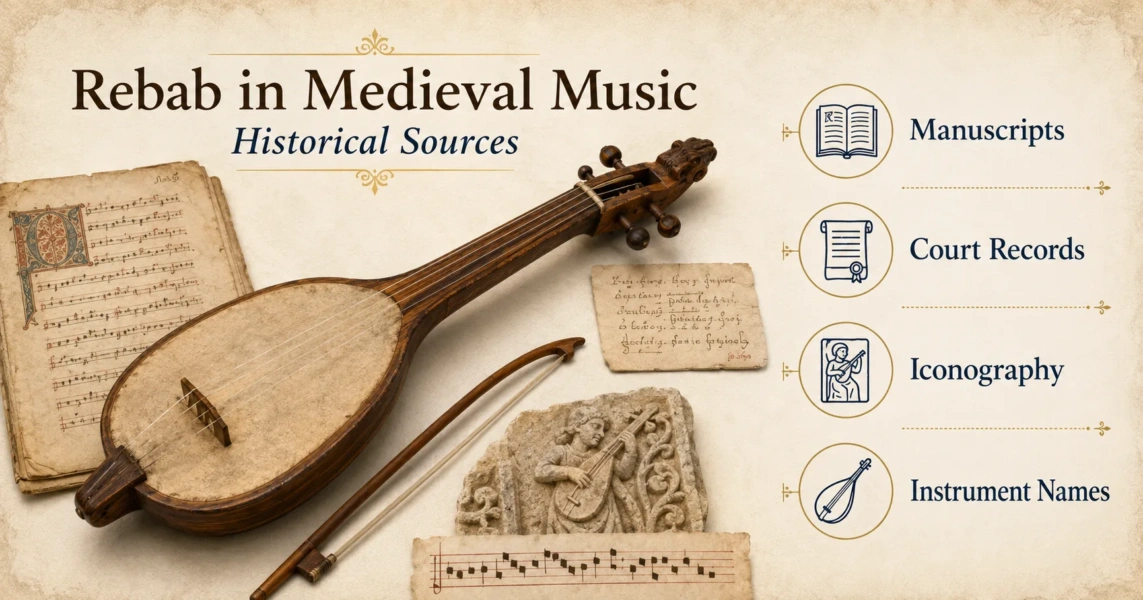
The rebab appears in medieval music less as a single fixed instrument than as a family name moving through languages, courts, manuscripts, and workshop traditions. In Arabic sources it is tied to bowed chordophones; in Iberian and European sources it appears through forms such as rubeba, ribabe, rabel, and rebec. The clearest picture comes from reading several kinds of evidence together: musical treatises, manuscript images, later museum instruments, and the language used by medieval writers.
What “Rebab” Means in Medieval Sources
The word rebab (also written rabab, rabāb, rubāb, rebap, or similar forms) did not always point to one identical object. In medieval and later regional use, it could describe bowed lutes, spike fiddles, boat-shaped fiddles, and related chordophones. This is why historical descriptions must be read with care.
In a medieval setting, the term usually signals a bowed string instrument associated with Arabic, Islamic, Andalusi, North African, or Mediterranean musical contact. In European sources, related names gradually become attached to the rebec, a small bowed instrument with a narrow pear-shaped or boat-shaped body.
Source Note: A medieval word is not the same as a modern museum label. A manuscript image may show an instrument that modern scholars call a rebab, rubeba, or rebec, while the image itself may not name it. The safest reading combines shape, playing position, string layout, bow use, and the language of nearby written sources.
Main Historical Source Types
The rebab enters medieval music history through four main source groups. Each source type offers useful evidence, but each also has limits.
| Source Type | Typical Example | What It Can Show | What It Cannot Always Prove |
|---|---|---|---|
| Arabic Music Treatises | Writings linked to medieval music theory and instrument description | Terminology, playing method, instrument classification, relation to other instruments | Exact regional form or surviving sound |
| European Treatises | Jerome of Moravia’s discussion of the rubeba | String number, tuning relation, bowing, comparison with the vielle | Every construction detail of the instrument |
| Manuscript Illumination | Instrument images in the Cantigas de Santa María | Body shape, playing posture, bow form, visible strings and possible soundboard materials | Hidden construction, exact dimensions, tuning, or a literal workshop plan |
| Later Museum Instruments | North African rebab, Bedouin rababah, Javanese rebab | Material clues, soundboard types, regional construction families | A direct one-to-one match with a medieval instrument |
Arabic and Islamic-World References
Arabic musical writing gives the rebab its earliest learned setting. Medieval writers used instrument names as part of broader discussions about sound, melody, tuning, and musical practice. The rebab appears in this environment as a bowed string instrument, often linked with a membrane-covered resonator or a small lute-like body, depending on region and period.
Al-Farabi’s tenth-century work on music is often discussed in relation to early Arabic instrument theory. It belongs to a scholarly tradition that treated instruments not merely as objects, but as tools for producing measurable pitch, melody, and musical expression. This matters because the rebab was not only a folk object in later memory. It stood close enough to learned music culture to be noticed by theorists.
Later Arabic historical writing also helps. Ibn Khaldun, writing in the fourteenth century, describes musical culture with attention to instruments, social setting, and practice. Such sources show that the rebab was understood as part of a living musical environment, not as an isolated curiosity.
Why These Written Sources Matter
Written sources do not give a full workshop plan. They rarely say exactly which wood was used, how thick the soundboard was, or how every player tuned the strings. Yet they are valuable because they show that medieval readers recognized the rebab as a known instrument category.
They also help explain why the name traveled so widely. A word attached to a bowed chordophone could move with musicians, courts, trade routes, poetic traditions, and regional ensembles. As it moved, the object behind the name could change.
The Rebab in Iberian Manuscript Images
The Iberian Peninsula is one of the richest places to study the medieval rebab visually. The thirteenth-century Cantigas de Santa María, produced between approximately 1264 and 1284 under Alfonso X of Castile, survives in manuscripts containing extensive musical notation and, in two of the codices, numerous instrument miniatures. Several of these images show bowed instruments identified in recent research as rababs.
These images are useful because they show instruments in the hands of players. A written name gives one kind of evidence; a painted player gives another. In the Cantigas, the instruments appear in courtly manuscript art, often paired with other musicians. This places them within a cultivated musical setting.
What the Cantigas Images Suggest
- A narrow, club-like body in the examples identified as the andalusī rabab type.
- A bowed playing method, with the bow held in an underhand grip in the examples compared by Thilo Hirsch.
- A vertical or slightly angled playing position with the instrument supported on the thigh.
- Two visible strings and two pegs on the three closely compared rabab depictions.
- A lower section of the soundboard that is very likely covered with skin or parchment, while the upper section appears to be wooden in these examples.
- A pegbox shown from an altered angle rather than in strict visual perspective.
The images should not be read as technical drawings. The apparently twisted pegboxes are a useful example. Hirsch and Marina Haiduk describe this kind of representation as aspectival: the artist may show different parts of an instrument from different viewpoints so that features that would otherwise be hidden remain visible. Copying such an image literally could therefore produce a construction that the medieval artist never intended to document.
From Cantigas Image to Playable Reconstruction
Thilo Hirsch’s 2025 study of the rabab in the Cantigas de Santa María goes beyond identifying instruments in manuscript illumination. Because no medieval rabab of this type survives, the reconstruction had to combine the Cantigas images with written evidence, later Iberian depictions, organological comparison, and later North African rabāb traditions.
The skin or parchment covering is one example of this process. In the three closely related Cantigas depictions examined by Hirsch, the lower third of the soundboard is very likely parchment-covered. Later images showing the instrument from other angles helped investigate features that the frontal Cantigas views leave hidden, including body depth and the way a skin top could be attached and shaped. Evidence from Moroccan rabāb construction was also used where medieval images alone could not answer questions about internal structure.
The resulting Cantigas-rabab prototype was built as a functional reconstruction rather than as a claim to reproduce one lost instrument exactly. The reconstructed instrument could then be played with melodies preserved in the Cantigas, allowing questions of range, tuning, bowing, and melodic treatment to be tested through performance rather than inferred only from pictures.
The Rubeba and Jerome of Moravia
One of the clearest European textual references is the rubeba described by Jerome of Moravia in the late thirteenth century. His Tractatus de Musica discusses stringed instruments and gives details that help separate the rubeba from the more familiar medieval vielle.
The rubeba is described as a bowed instrument with two strings, set a fifth apart. This is a small detail, but it matters. It shows that the instrument was not only seen in pictures; it was also known well enough to be described by a music theorist.
Jerome’s text also suggests that the rubeba did not hold the same central position as the five-string vielle in northern European learned discussion. That does not make it minor in every musical culture. It means that, in his setting, the rubeba was treated as a distinct bowed instrument with a narrower role than the more established fiddle.
Luthier’s Note: A two-string bowed instrument set a fifth apart behaves differently from a larger five-string fiddle. It encourages a more focused melodic range and can support drones, parallel motion, or strong modal color. The exact sound depends on body shape, string material, bow tension, bridge shape, and whether the soundboard is wood, skin, or a mixed construction.
From Rebab to Rebec: A Careful Line of Influence
The European rebec is often linked to the Arabic rebab. The link is reasonable, both in naming and in instrument shape, but it should not be flattened into a simple one-step origin story. Medieval bowed instruments developed across several regions at the same time, and names shifted as musicians adapted instruments to local habits.
The rebec usually has a small, narrow, pear-shaped or boat-shaped body. It is bowed, often fretless, and commonly described with three strings in later medieval and Renaissance contexts, though the number could vary. Its body is generally carved rather than built with the flat ribs and plates associated with later viols and violins.
The rebab connection is strongest in the shared bowed technique, the rounded or boat-like body forms, and the movement of related names through Arabic, Romance, and Latinized forms. In Iberia and the western Mediterranean, this contact zone was especially active.
Where the Difference Begins
A North African rebab and a European rebec are related in historical discussion, but they are not identical objects. The North African instrument may use a skin soundboard and a body held across the player’s body. The rebec, as it develops in Europe, becomes more closely tied to medieval and Renaissance fiddle practice.
This is the useful distinction: rebab is the wider historical and regional family name; rebec is a European bowed instrument shaped by that contact but developed in its own musical setting.
Construction Clues in Historical Descriptions
Medieval sources rarely describe the rebab with the precision of a modern instrument catalog. Even so, several recurring construction clues appear across the evidence.
Body and Resonator
Many rebab-family instruments use a small resonating body. Some are boat-shaped or pear-shaped. Others are spike fiddles with a narrow neck passing through or into the body. In North African examples, a hollowed wooden body may be combined with a skin or parchment soundboard. In other regional forms, the resonator may be round, rectangular, coconut-shell based, or otherwise locally adapted.
Soundboard
A skin soundboard gives many rebab-family instruments a direct, dry, and vocal tone. It can react quickly under the bow, but it may also change with humidity and tension. Wood-covered forms can sound different, but historical evidence does not support one universal rebab sound.
The Cantigas evidence is more specific than a general label such as “skin-covered fiddle” may suggest. In the examples examined in the 2025 reconstruction study, the lower part of the top is interpreted as parchment-covered while the upper section is probably wood. This mixed construction also helps explain why a manuscript image should be examined part by part rather than assigning one material to the entire visible surface.
Strings
Medieval and early modern bowed instruments often used gut or other organic string materials. Some regional rebab forms used horsehair or metal in later examples. The number of strings varied by form: one-string rababah types, two-string North African forms, and three-string rebec-like forms all appear in the wider family.
Fingerboard and Frets
Many rebab-family instruments are fretless. Some do not use a full fingerboard in the modern violin sense. On certain forms, the player stops the strings by touching them from the side or pressing them without a long raised fingerboard. This helps explain why the rebab should not be imagined as a small violin with a different outline.
How It Functioned in Medieval Music
The rebab’s role in medieval music is best understood through function rather than surviving solo repertory. The instrument appears around song, courtly entertainment, poetic performance, and ensemble playing. It could support a melody, double a voice, add a bowed drone, or color a modal line.
In Arabic and Andalusi contexts, bowed instruments were part of refined musical practice as well as regional performance. In European settings, related forms such as the rubeba and rebec entered the soundscape of minstrels, courts, dance music, and mixed instrumental groups.
The instrument’s voice was probably valued for its ability to sustain tone. Plucked lutes speak clearly and decay quickly; a bow can extend a note, lean into ornament, and imitate vocal curves. That made bowed instruments useful beside singing.
The reconstructed Cantigas rabab provides a way to test some of these ideas against surviving music. Hirsch examined how a two-string instrument with a limited range could approach Cantigas melodies and considered practical solutions such as transposition and moving portions of a melody by an octave when necessary. These tests do not prove one medieval performance method. They show which solutions are physically and musically workable on a reconstruction based on the surviving evidence.
Listening Note: Modern reconstructions of medieval rebab or rebec sound should be treated as informed interpretations. They can test tone color, bow response, range, tuning, and melodic use, but they cannot reproduce a single fixed medieval sound. The Cantigas-rabab prototype is useful precisely because it turns a reconstruction hypothesis into something that can be played and tested.
Why Manuscript Images Need Caution
Manuscript images are tempting because they look direct. A painted player seems to answer everything at once. In practice, iconography must be read slowly.
A medieval artist may show a bowed instrument clearly enough to identify a family, yet not clearly enough to confirm the exact bridge curve, tuning, number of strings, or body depth. Decorative style can also change the outline. A pegbox may be rotated to make its pegs visible, proportions can be altered, and surfaces may carry symbolic or compositional meaning rather than serving as literal construction records.
Hirsch and Marina Haiduk’s 2025 study proposes a four-step method for moving from pictorial evidence toward instrument reconstruction. It begins by establishing the artwork’s date, provenance, medium, condition, function, and wider context. The depicted elements are then described before assigning them a meaning, including an assessment of how closely the instrument appears to follow a physically plausible object. Iconographic interpretation follows, placing the image within its subject and historical setting. Only after those stages does organological interpretation begin, separating visible construction evidence from parts that must be reconstructed through comparison and informed interpolation.
This method is especially relevant to the Cantigas. A frontal miniature can preserve useful evidence about strings, posture, bow grip, body outline, and surface materials while saying little about body depth or internal construction. Later images and other source types can help with those missing features, but they do not turn the illumination into a technical blueprint.
Images remain valuable evidence. They show how instruments were represented, recognized, and placed in musical life. Their strongest use comes when visual details agree with other images, written descriptions, organological evidence, and practical testing.
Regional Names and Spelling Variants
The rebab’s medieval history is also a history of names. As the instrument moved through Arabic, Persian, Turkish, Iberian, and European settings, spelling changed. These names are not random mistakes; they preserve the path of cultural contact.
| Name Form | Common Context | Typical Meaning in Historical Discussion |
|---|---|---|
| Rabab / Rabāb | Arabic and Islamic-world sources | A bowed chordophone or related string instrument, depending on region |
| Rebab / Rebap | Turkish, Southeast Asian, and broader transliteration use | Often a bowed lute or spike fiddle in regional traditions |
| Rubeba | Latin medieval theory | A bowed instrument described in relation to medieval string practice |
| Rabel | Iberian use | A bowed folk or medieval-derived fiddle form |
| Rebec | Medieval and Renaissance Europe | A small bowed instrument linked by name and form to the rebab family |
What Historical Sources Do Not Tell Clearly
Several details remain uncertain. This is normal for medieval instrument history.
- There was no single medieval rebab standard shared by all regions.
- String number varied by instrument type and period.
- Images may not label the instrument being shown.
- Written names may describe a family rather than a single construction.
- Visible manuscript details do not automatically reveal hidden construction.
- Modern museum objects often come from later centuries, so they help with comparison rather than direct proof.
- Playable reconstructions test hypotheses about medieval practice; they are not surviving medieval instruments.
These limits make it necessary to compare different forms of evidence instead of depending on one image, one name, or one later instrument.
How to Recognize a Rebab-Type Instrument in Medieval Art
A careful visual reading starts with the whole object, not one feature. A bowed instrument with a small rounded body may be a rebab-type form, but it could also be a vielle, lyra, early fiddle, or later rebec depending on context.
- Look for a bow and the direction of bow contact.
- Check whether the body is boat-shaped, pear-shaped, round, or built like a larger fiddle.
- Observe the playing position: lap, knee, chest, shoulder, or vertical spike position.
- Count visible strings only with caution, since artists can simplify them.
- Check whether apparent perspective changes may be aspectival rather than literal construction details.
- Compare the instrument with other objects in the same manuscript.
- Use nearby text, regional setting, date, and comparable sources before naming it too firmly.
Rebab, Vielle, and Rebec Compared
The rebab is often confused with the vielle and rebec because all three belong to the medieval bowed-instrument landscape. The distinctions are useful, even when individual sources blur them.
| Instrument | Usual Form in Discussion | Playing Method | Main Historical Clue |
|---|---|---|---|
| Rebab | Regional bowed chordophone; may be boat-shaped, spike-like, or membrane-covered | Bowed, sometimes with special stopping technique | Arabic and Mediterranean terminology; later regional survivals |
| Vielle | Medieval European fiddle, often larger and more developed for courtly use | Bowed | Frequent in European art and music writing |
| Rebec | Small European bowed instrument, often narrow and pear-shaped | Bowed, usually held higher than many rabab forms | Name and form linked to rebab/rubeba traditions |
Why the Rebab Matters to Medieval Music History
The rebab matters because it sits at the meeting point of instrument making, language, and musical exchange. It shows how a bowed sound could move from Arabic and Mediterranean contexts into European musical life, while changing form along the way.
Its history also warns against treating medieval instruments as fixed museum categories. A name could travel faster than a construction detail. A playing method could survive while the body shape changed. A regional instrument could enter a manuscript image without a label, then be renamed centuries later by scholars.
The Cantigas reconstruction research adds another type of evidence to this history. Manuscript images can now be compared not only with texts and later instruments but also with the behavior of a playable reconstruction. That does not remove uncertainty. It allows proposed construction and performance choices to be tested against the physical instrument and the surviving medieval melodies.