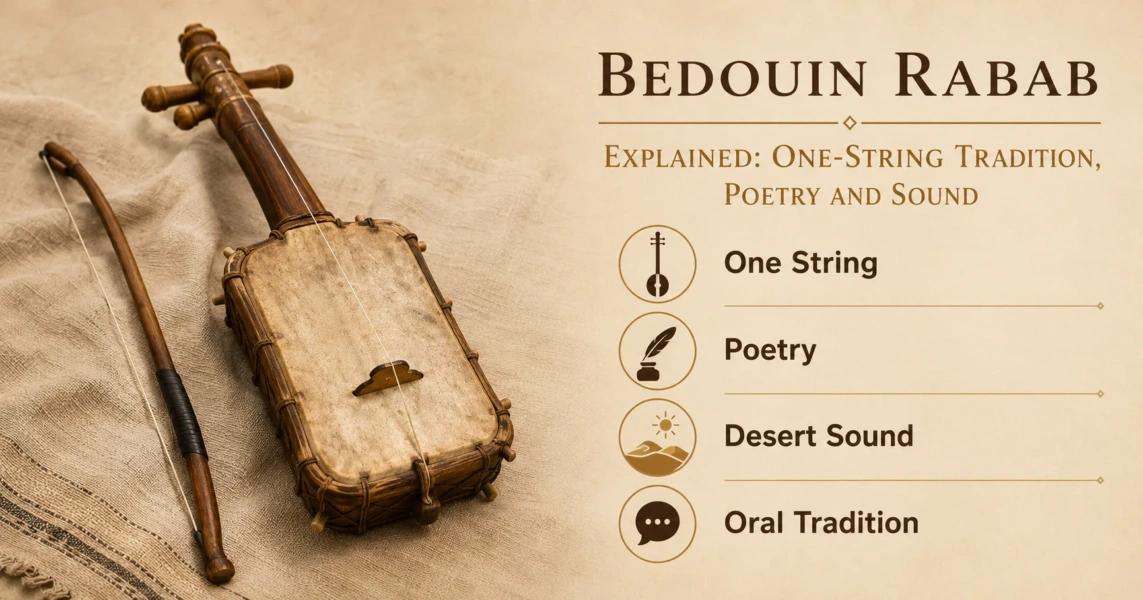
The Bedouin rabab is a bowed spike fiddle built for voice, not volume. In its best-known desert form, it often has one horsehair string, a skin-covered sound box, a long neck or spike, and a bow that draws a narrow, speech-like tone from the instrument. Its close link with sung poetry is not an ornament to the tradition; it explains the instrument’s shape, range, and sound.
What the Bedouin Rabab Is
The Bedouin rabab, also written rababa, rabāba, rebab, or rabab, is a simple bowed chordophone associated with Arabic-speaking pastoral and rural traditions in parts of the Middle East. The name can point to more than one regional instrument, so context matters.
In the Bedouin setting, the term usually refers to a one-string bowed fiddle used to support recited or sung poetry. The instrument is held upright, and a spike or lower stem may rest on the ground, on the performer’s leg, or against the body depending on the local playing habit.
| Feature | Common Bedouin Form | Why It Matters |
|---|---|---|
| Instrument type | Bowed spike fiddle | The neck or rod continues through or below the resonator, giving the instrument its upright playing position. |
| String count | Often one main string | A single string is enough for flexible melodic lines that follow the voice. |
| String material | Traditionally horsehair in many documented examples | The material helps produce a dry, textured tone rather than a polished violin-like sound. |
| Soundboard | Skin or parchment stretched over a frame | The membrane gives the sound a focused, nasal edge and quick response. |
| Main use | Poetry, sung narration, and vocal support | The rabab often works as a tonal companion to the performer’s voice. |
Names and Spellings
The spellings rabab, rababa, rabāba, and rebab often appear in English-language writing. They reflect different transliterations rather than one fixed spelling system. The Arabic form behind many of these spellings is commonly linked with bowed lute or fiddle traditions across a wide area.
For the Bedouin instrument, rababa and rabāba are especially common in museum and ethnographic descriptions. Some sources also use rabab ash-sha’ir, often understood as a “poet’s fiddle.” In some Egyptian naming traditions, related terms distinguish a one-string poet’s fiddle from a two-string singer’s fiddle, though those distinctions are not always kept in everyday use.
Regional Note: The name rabab does not always mean a one-string Bedouin instrument. In North Africa, South Asia, Central Asia, and Southeast Asia, related names can refer to two-string bowed lutes, plucked rubabs, or other local forms. The body, playing method, and string layout should be checked before identifying the instrument.
Body Shape and Construction
The Bedouin rabab is usually plain in outline. Many examples have a quadrilateral sound box, often described as square, rectangular, or slightly tapered. A wooden frame carries the skin cover, and the neck or rod passes through the resonator. The lower end may form a spike.
The resonator is not large. It does not need to fill a concert hall. It needs to carry a voice-like line clearly enough for poetry and intimate performance.
Sound Box
The sound box is commonly made from wood and covered with skin or parchment. In some documented instruments, skin covers both front and back. The sides may be sewn or joined in a direct craft style, with little separation between structural work and visible finish.
This box shape helps separate the Bedouin rabab from round-bodied spike fiddles such as some kamancheh-related forms, and from coconut-shell rababa types found in other Arabic musical settings.
Neck, Spike, and Peg
A single peg is enough when the instrument has one string. The peg sits near the upper part of the neck and holds the string tension. The long stem gives the instrument a vertical axis, allowing the player to bow the string while the resonator rests below the hand.
On older instruments, missing strings or loose fittings are common. Peg holes, bridge marks, and the path of the neck through the body can tell more than the current condition of the object.
String and Bow
Many Bedouin rabab examples are described with a horsehair string and a horsehair bow. The bow is usually simple, and the playing action is close to the body. The string may be stopped with the finger or touched lightly, depending on the form and the performer’s technique.
Luthier’s Note: A one-string rabab should not be judged by the standards of a violin. Its narrow range, light body, and membrane soundboard suit a different task: shaping pitch around the human voice with direct, flexible motion.
Why One String Is Enough
The one-string design is often misunderstood. It is not a reduced version of a larger instrument. It is a focused design for melodic support.
A single bowed string allows the player to slide, lean into notes, and follow the rise and fall of sung poetry. The music does not depend on chords. It depends on contour, rhythm, pitch shade, and the timing between the voice and the bow.
- Range is limited, but usable: The performer works inside a narrow pitch field and shapes it carefully.
- Pitch can bend: The absence of frets allows flexible intonation.
- The tone stays close to speech: The sound can mirror the pressure and pacing of recitation.
- The instrument remains portable: The light build suits travel and informal performance settings.
Sound and Playing Feel
The Bedouin rabab often has a dry, nasal, and slightly grainy sound. The tone is not meant to be smooth in the modern orchestral sense. It has a narrow beam and a vocal edge.
The skin soundboard responds quickly, while the horsehair string and bow can produce a textured attack. The result is a tone that can sit beside a singer without covering the words.
Listening for the Rabab Voice
The sound often feels close to recitation. Notes may begin with a small scrape, then settle into a steady pitch. Slides and ornaments can carry more meaning than fast note patterns.
The player may use repeated notes, short bowed phrases, and open-string resonance to support the poem’s rhythm. Silence also matters. The rabab can leave space for the line of verse to land.
Listening Note: A Bedouin rabab performance should be heard as voice-centered music. The instrument often frames the poem rather than competing with it. Its tone may sound spare at first, but that spareness is part of its function.
Poetry and Performance Role
The Bedouin rabab is closely linked with sung poetry, oral narration, and solo vocal performance. In many descriptions, it appears as the instrument of the poet-singer: a small bowed companion that marks pitch, mood, and continuity.
The instrument can support long poetic lines without requiring complex accompaniment. It offers a drone-like center, short melodic turns, and a recognizable tone color. This makes it useful where the words carry much of the artistic weight.
How It Supports the Voice
The rabab can begin a phrase, answer a phrase, or hold a tone under the voice. It may also help the performer maintain a tonal center during recitation. The sound is lean enough that consonants and vowel shapes remain clear.
- The performer sets a tonal area with the string.
- The voice enters with a poetic line or sung phrase.
- The bow follows, answers, or rests between lines.
- The instrument returns to a familiar tone, giving the performance continuity.
Materials and Their Effect on Tone
Materials on a Bedouin rabab are usually direct and functional: wood, skin or parchment, horsehair, and sometimes metal fittings. Decoration varies. Some instruments are plain, while others carry carved, painted, or applied details.
Wood choice can shape resonance, but the instrument’s sound also depends on skin tension, body size, string material, bow pressure, and the player’s touch. No single material explains the whole tone.
| Part | Material Often Seen | Practical Role |
|---|---|---|
| Frame or body | Wood | Forms the resonator and supports the stretched membrane. |
| Soundboard | Skin or parchment | Responds quickly to string vibration and gives a focused tone. |
| String | Horsehair in many traditional examples | Produces a textured bowed sound suited to vocal support. |
| Bow hair | Horsehair | Grips the string and allows sustained tone. |
| Peg or fittings | Wood, sometimes with metal elements | Holds string tension and allows basic tuning adjustment. |
How It Differs from Related Instruments
The Bedouin rabab belongs to the wider rebab and rabab name family, but it should not be merged with every instrument that shares a similar name. The most useful differences are playing method, body form, and string layout.
Bedouin Rabab and Afghan Rubab
The Afghan rubab is a plucked short-necked lute, often carved from mulberry wood and fitted with several string groups. It has a skin-covered resonating area and a fuller plucked sound. The Bedouin rabab is bowed, usually one-string in its classic poet-fiddle form, and built around vocal support.
Bedouin Rabab and North African Rabāb
North African rabāb forms from Morocco, Algeria, and Tunisia may be short-necked bowed lutes used in ensemble settings. They can have different body shapes, decorative fingerboards, and playing contexts. The Bedouin rabab is more closely tied to the poet-singer role and a lighter spike-fiddle structure.
Bedouin Rabab and Kamancheh
The kamancheh is also a bowed spike fiddle, but it usually has a rounded resonator and a different performance tradition. Modern kamancheh forms often have several strings and a wider melodic range. The Bedouin rabab remains more spare in construction and sound.
Bedouin Rabab and Rebec
The European rebec shares a historical name connection with rabab-type bowed instruments, but it developed in a different musical setting. The rebec usually has a carved wooden body and multiple strings. Its sound and repertory should not be treated as the same as the Bedouin rabab.
Common Misunderstandings
Several errors appear often when the Bedouin rabab is described too broadly.
- It is not always the same as the Afghan rubab. One is commonly bowed in this context; the other is plucked in its best-known Afghan form.
- One string does not mean incomplete. The design serves poetry and vocal line rather than chordal playing.
- The name alone is not enough for identification. Body shape, string count, bow use, and region all matter.
- The sound is not meant to imitate the violin. Its tone is narrower, drier, and more speech-like.
Identifying a Bedouin Rabab in a Collection or Performance
A viewer can often recognize the Bedouin rabab by combining several clues. The safest identification comes from structure, not spelling.
- Look for a four-sided or simple box-like resonator covered with skin.
- Check whether the instrument has one main string.
- Look for a long neck or spike passing through or below the body.
- Confirm that it is played with a bow.
- Notice whether the performance centers on sung poetry or solo vocal narration.
Collector’s Note: Older rabab instruments may appear fragile or incomplete. A missing string, loose bridge, or replaced skin does not erase the instrument’s identity. The body shape, peg arrangement, and spike construction can still point to its original use.
Tuning and Pitch Practice
Published descriptions of Bedouin rabab tuning are not always uniform. That is expected for a handmade one-string instrument tied to voice and local habit. The string is tuned to suit the performer’s range, the poem, and the tonal center used in performance.
Because the instrument has no fretted fingerboard, pitch is shaped by touch. The performer adjusts the line by ear. For this reason, a fixed Western note name is often less useful than understanding the rabab as a flexible vocal-support instrument.
Place in the Wider Rebab Family
The Bedouin rabab shows one end of the wider rebab family: bowed, spare, portable, and close to recitation. Other relatives in the name family may be plucked, multi-stringed, ensemble-based, or heavily decorated.
This variety is part of why the instrument family can be confusing. A reader may find a one-string Bedouin rababa, a two-string Egyptian rababa, a North African rabāb, a Javanese rebab, or an Afghan rubab under related spellings. The shared name does not create one standard design.
The Bedouin form remains distinct because its structure and musical use point in the same direction: a single bowed line serving the human voice.
FAQ
Is the Bedouin rabab the same as a rababa?
In many English descriptions, the Bedouin one-string fiddle is called rababa or rabāba. The spelling rabab is also used. The safest approach is to check the region, body shape, string count, and whether the instrument is bowed.
Does every Bedouin rabab have one string?
The best-known Bedouin poet-fiddle form often has one string, but related Arabic rababa forms may have two strings or different resonators. Handmade instruments also vary by region and maker.
What is the Bedouin rabab used for?
It is strongly associated with poetry, sung narration, and vocal support. The instrument gives the performer a tonal center and a short bowed melodic line that can follow the rhythm of the words.
What does a Bedouin rabab sound like?
It usually has a dry, nasal, textured tone. The sound is narrow and speech-like rather than broad and polished. This helps it sit close to the voice without covering the poetry.
Is the Bedouin rabab hard to learn?
The basic structure looks simple, but good playing needs careful ear control. The player must manage bow pressure, pitch shading, and timing with the voice. The difficulty is in expression, not in a large number of strings.
How is the Bedouin rabab different from the Afghan rubab?
The Bedouin rabab is a bowed instrument, often with one string in the poet-fiddle form. The Afghan rubab is a plucked lute with several string groups and a fuller resonant body. The names are related, but the instruments serve different musical settings.